A vanished city lives again...

Showing posts with label west adams. Show all posts

Friday, July 28, 2017

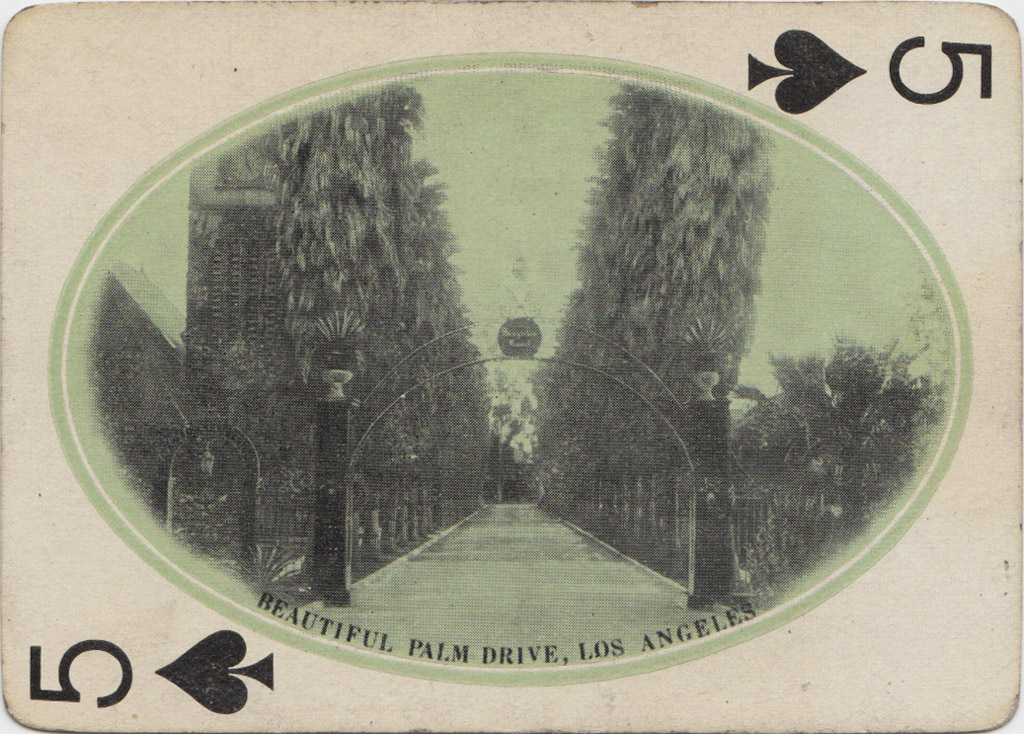
The 5 of Palms

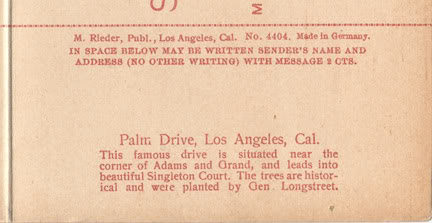
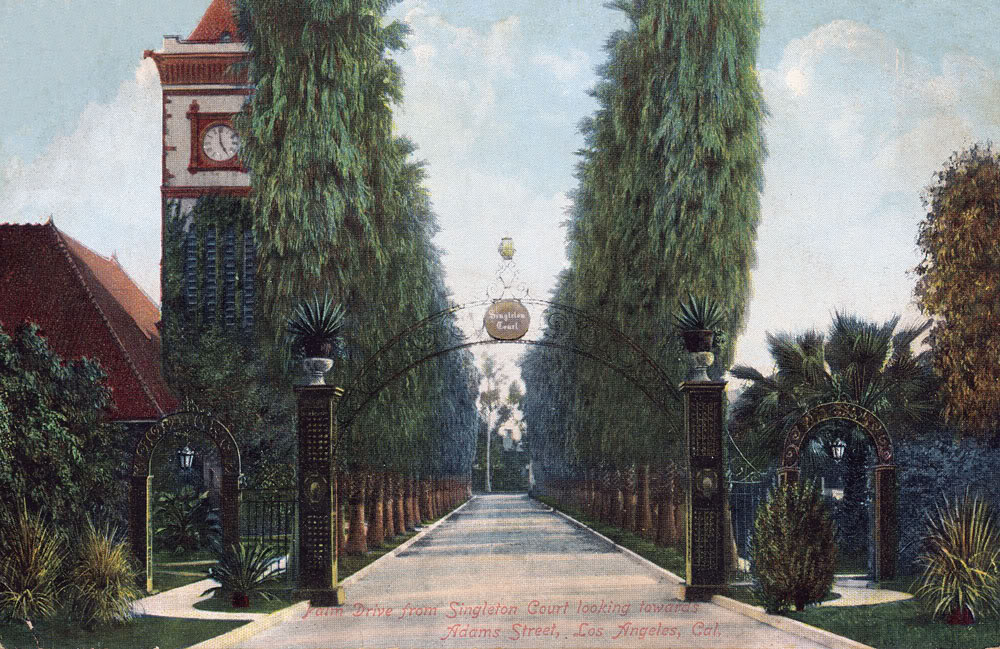
Nitrocellulose playing card by postcard maker M. Rieder depicting Palm Drive and the entrance to Singleton Court, 1907.


Saturday, November 5, 2011

Palms puzzle finally solved

For the better part of five years, I have been curious about the origins and subsequent history of the "Longstreet Palms," which may be the oldest trees in Los Angeles. Yesterday, reader Bradford Caslon pointed me to this online excerpt from the 2008 Images of America book, "West Adams," by Suzanne Tarbell Cooper, Don Lynch and John G. Kurtz, which has provided the crucial last pieces of the palms puzzle.

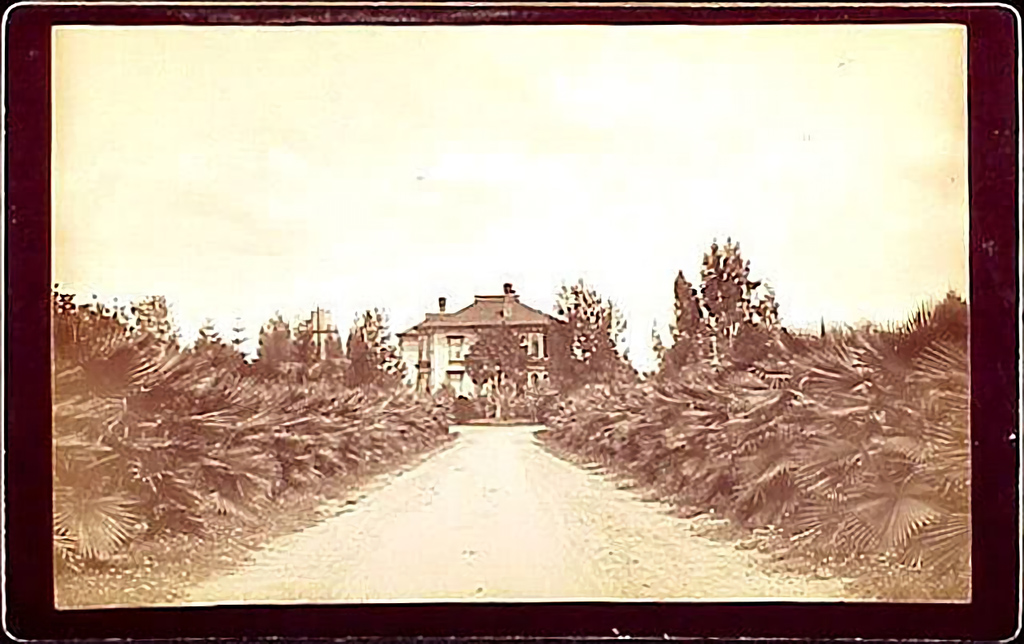
The authors make clear something that I have known for some time: that the "Longstreet" whose name is associated with the ancient palms is NOT the Confederate Civil War General James Longstreet. The man who built the mansion off West Adams Boulevard with its once-world-famous twin lines of Washingtonia fan palms was a Mister Charles Longstreet, who died in Los Angeles in 1877. The year of his death suggests that the date given by the USC Digital Library for one of the earliest photos of Palm Drive (c.1875) is very likely correct. The even older image below (the earliest-known photo of the Longstreet Mansion and Palm Drive) therefore probably dates to c.1870, which I now feel comfortable assigning as the time that the palms were actually planted. Since fan palms of that height are no less than 5 years old, I therefore believe it has now been conclusively established that these trees did, in fact, begin their lives during the American Civil War, approximately 150 years ago.


Dating to c.1865, then, these palms are older than almost every man-made structure not only in Los Angeles, but in all of Los Angeles County, as well. I am so gratified to know that the remaining palms are now recognized for their historical significance by the good people of Los Angeles Orthopaedic Hospital, who I'm sure will protect these venerable Civil War veterans for as long as they shall live.

Finis.


Friday, January 1, 2010

Year of the palm?

Will 2010 be the year that I can finally tell the whole story of the Longstreet palms in West Adams? Here's hoping! I've kind of come to an impasse in my own research, unfortunately, as I do not live in the Los Angeles area and so do not have access to the libraries and archives which likely hold the answers I seek.

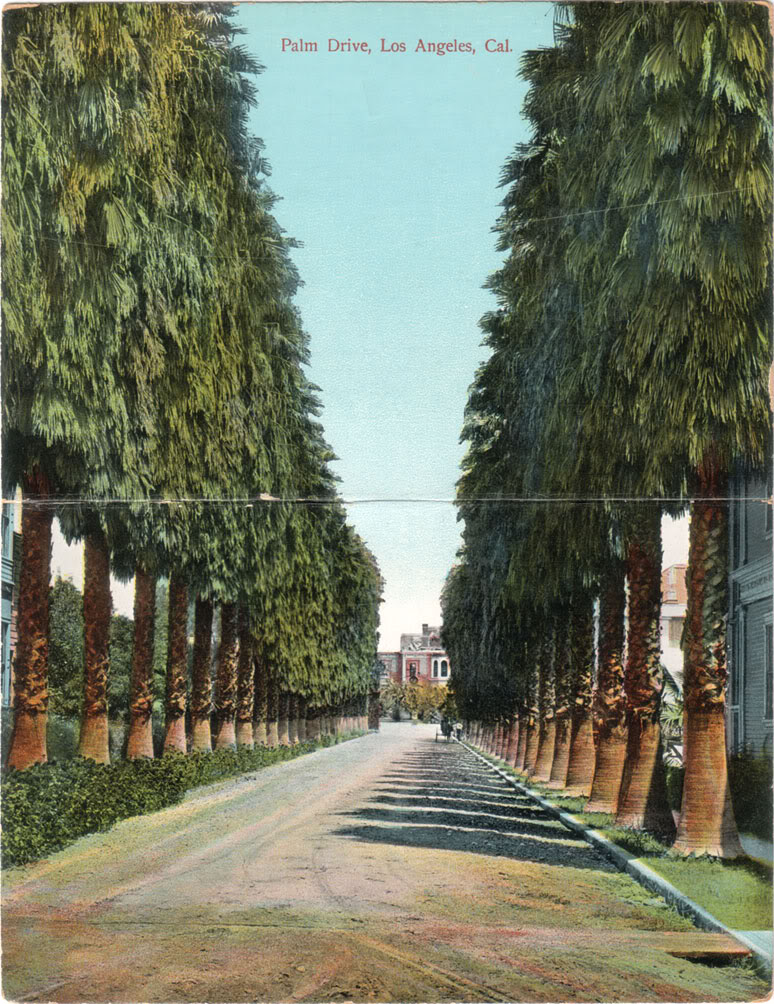
In the meantime, I recently obtained this unusual "double postcard" of the palms which dates to around 1907. The detail in the enlarged card is remarkable, I think. In this picture, I can distinctly see the Singleton Court gateway in the distance all the way from Adams Street.


Interesting caption on the card. Palm Drive is referred to as being "famous," and the palms "historical" for being "planted by Gen. Longstreet."


Makes me wonder when (and why) the Longstreet palms stopped being famous and became all-but-forgotten relics of Los Angeles's past.

Read the final installment in the saga of the Longstreet Palms: 'Palms puzzle finally solved'


Sunday, October 4, 2009

Palm Drive: Then & Now

Nathan Marsak recently sent me this lush postcard image of the palm drive of Singleton Court in West Adams, circa 1915. These are the Longstreet palms which I've written about previously. Planted circa 1875, the 23 Longstreet palms that remain today are quite possibly the oldest living things in Los Angeles. These trees have a continuous documented photographic history which alone affirmatively attests to their great age.

Palm Drive, Singleton Court, West Adams, c.1915:


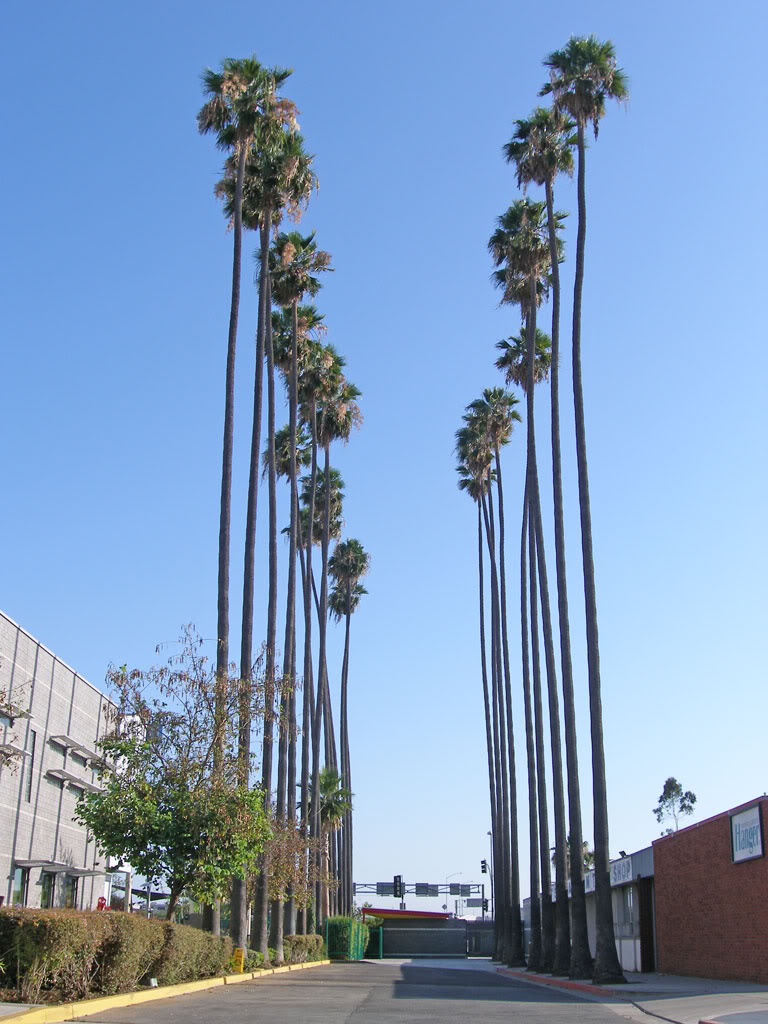
The same view of Palm Drive, 2009:


Photo by J Scott Shannon.


These palms actually began life during the Civil War, almost a century and a half ago. Only five buildings still standing in all of Los Angeles are older (dead link) than these palm trees. They may look just like any others, but the Longstreet palms are really quite special, indeed...


Friday, August 14, 2009

Whose palms are these, anyway?

Seems I've uncovered a bit of a mystery. Here, previously, I've told the story of "General Longstreet's palms." In it, I related information I found on the USC Digital Library site which stated that the palms and the house pictured in these two photos were on property owned by Confederate General James Longstreet, most notably of the Battle of Gettysburg fame.


Trouble is, subsequently, I have never been able to independently corroborate that James Longstreet ever lived in Los Angeles, or that he even owned property there. No biography of the man that I've been able to find thus far has him setting foot in California during his entire life.

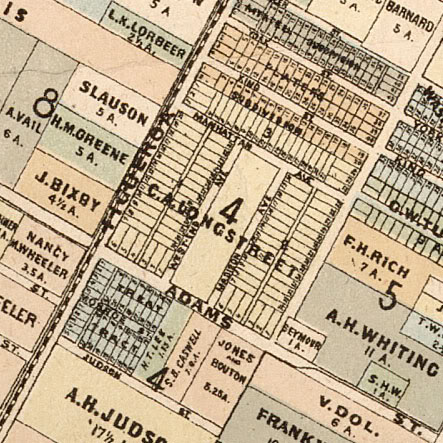
Then, the other day, thanks to reader Gregg D'Albert, I got pointed to the hypercities site, and there I found an 1884 map of Los Angeles showing the ownership of plots of land in the old city. Of course, the first thing I did was go to Figueroa and Adams to see who owned the Longstreet palms.


Well, as you can see, the tract in question was, indeed, owned by a Longstreet, but it was "C.A. Longstreet," not "J. Longstreet." Puzzling. Then I thought, wait, there was that 1938 Nuestro Pueblo article about the palms that also referred to a General Longstreet. Surprise! I'd missed the fact previously that that article referred to a Gen. Joseph Longstreet, not James Longstreet. Also, this Joseph Longstreet's wife was named Lucy, not Louise, and Lucy had died in 1917, versus 1890 for the CSA General's wife.

So, who then was General Joseph Longstreet, and how was "C.A. Longstreet" related to him? I've tried finding info about the other Longstreet on the web, but my search has gone nowhere yet.

Whatever Gen. Longstreet planted those palms, though, they still remain historically significant as possibly the oldest living things in Los Angeles. It would have been nice to be able to connect them with the famous General Longstreet, but even a not-so-famous General Longstreet will do just as nicely, too. ^^

Read the next installment in the saga of the Longstreet Palms: 'Year of the palm?'


Sunday, July 26, 2009

The palms yet live!

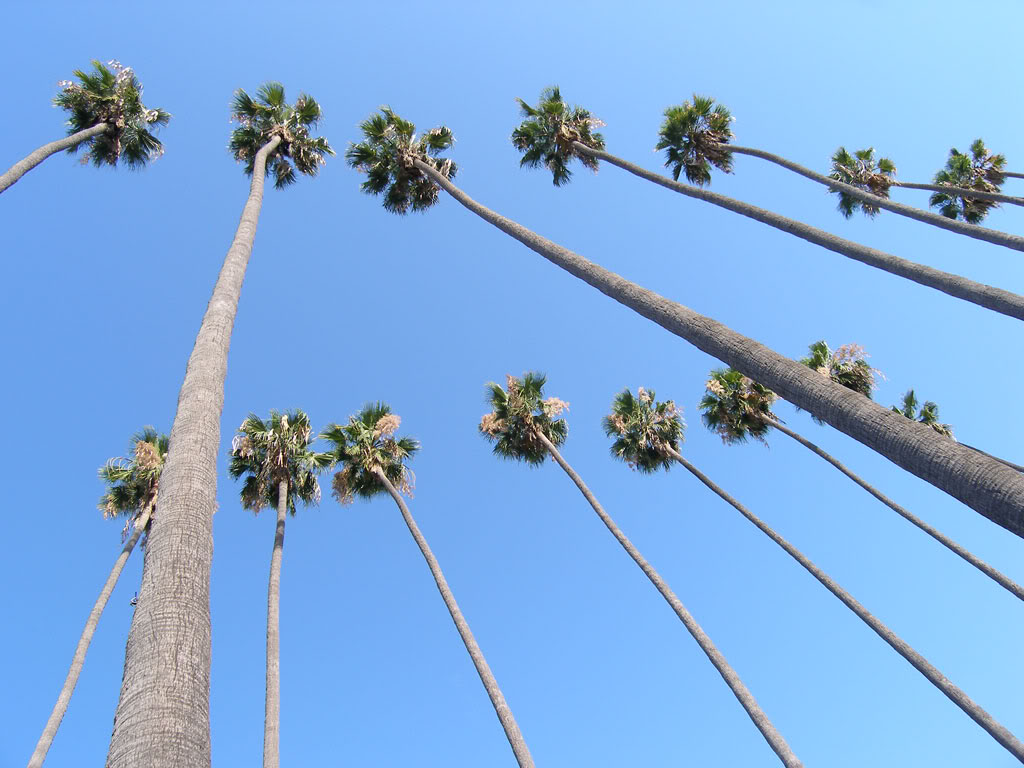
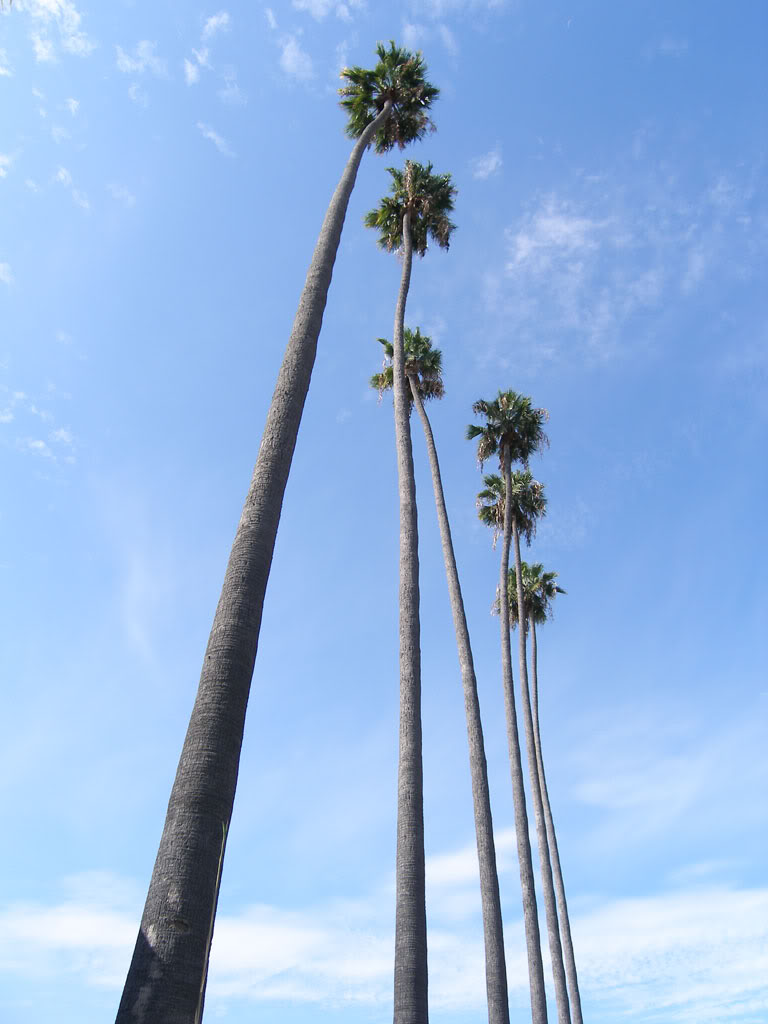
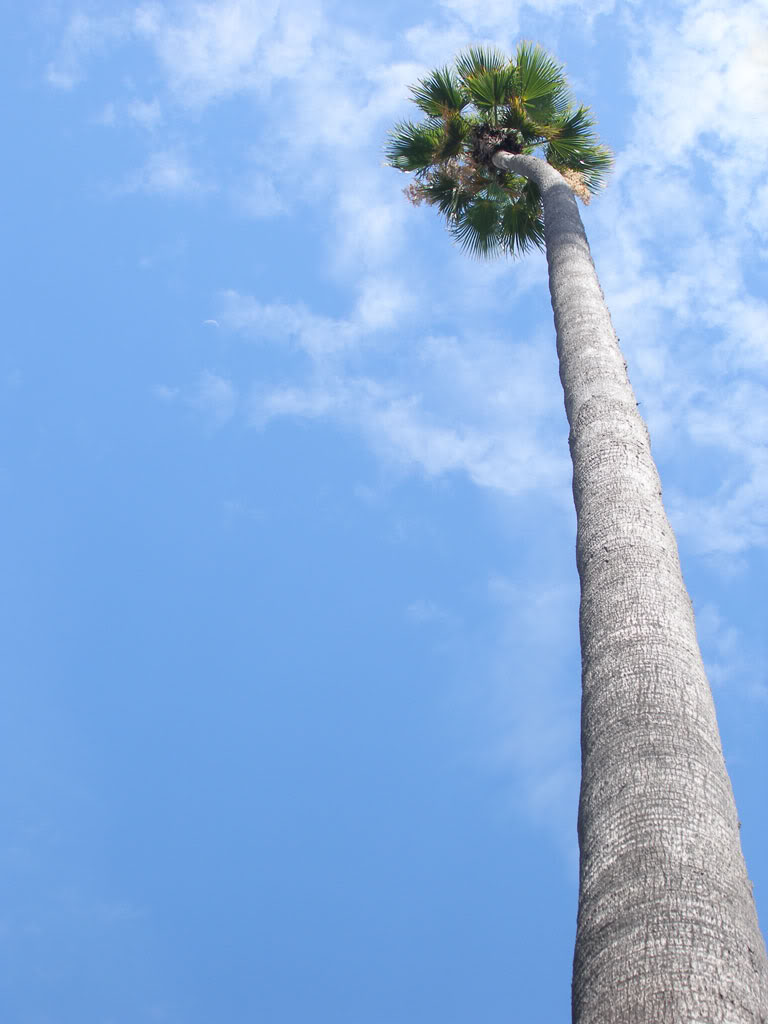
I've just returned from my first visit to Los Angeles in 10 years, and by far, the greatest thrill of my trip was seeing that at least some of General Longstreet's ancient palm trees in West Adams are still alive. After reading this, I was genuinely afraid that all of the old palms might have been removed by now. What a relief it was to see that my fears were not realized.

Here's a gallery of palm pics taken during my visit on July 17. Thanks to Deborah Justice at Orthopaedic Hospital for granting me permission to take photos on the site.

Many of the 150-year-old palms have been removed over the decades, but 23 of them are still thriving today...


Photo by J Scott Shannon.


The palms are in their full summer bloom now and are still robustly healthy, despite their great age and having been immediately adjacent to the bustling, smog-belching Harbor Freeway for the last third of their almost impossibly long lives.


Photo by J Scott Shannon.


Photo by J Scott Shannon.


Photo by J Scott Shannon.


What a joy it was to be in the presence of these Civil War-era veterans. Los Angeles historically has been characterized by impermanence, but these palms are a living testament to endurance in the face of constant change. All in all, theirs is quite an inspiring story. I consider it an honor to have passed that story on to Angelenos of the 21st century...


Sunday, July 20, 2008

The Longstreet Palms: The oldest trees in Los Angeles?

EDIT (10/2/2021): Please note that this article contains many statements which, through subsequent research, I discovered are factually incorrect, especially the alleged connection to Confederate General James Longstreet. Click on the "longstreet palms" tag here or at the bottom of the page to read the most recent and accurate findings on this very interesting subject!

It's funny how things that we don't pay any attention to at first can gradually worm their way into our consciousness and eventually become an obsession.

Here's how one such obsession of mine began. As you can tell from my blog, one of my hobbies is collecting postcards of old Los Angeles; a common subject of which is a "palm drive" or "palm avenue," depicting a street lined usually on both sides with either native or exotic palm trees. Stereotypical California scenes, I thought, of no real noteworthiness. So, I generally ignored these palm-themed postcards – my specialty is downtown street scenes and buildings – but after a while, I started to notice that a lot of the really old palm postcards appeared to depict one specific location: one on or near West Adams Street.
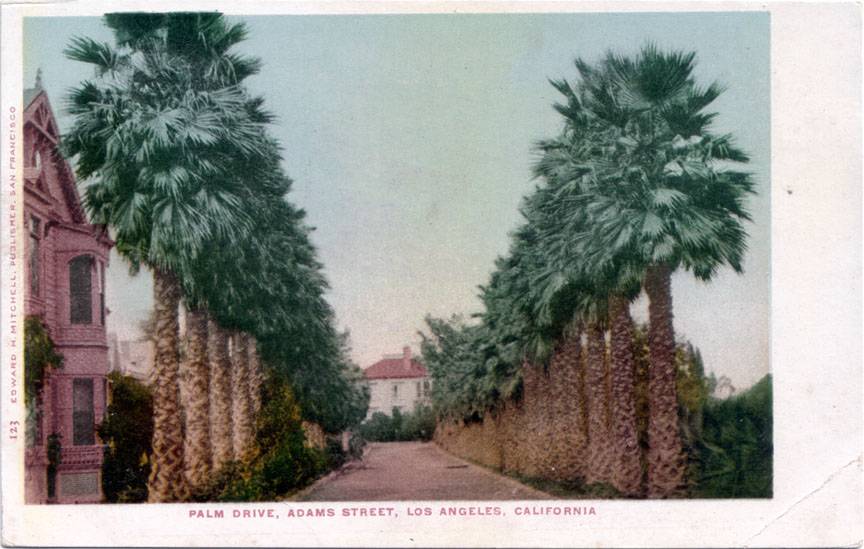


Curious, I looked it up in my 1941 "Hill's Guide" of Los Angeles, and was somewhat surprised to learn that Palm Drive was an actual place.
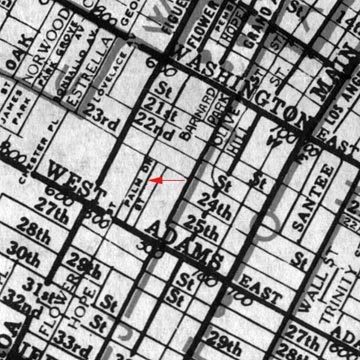


Then, I went to Google Maps to check the location today. I recognized the area immediately. It's an old memory from my childhood, actually. Palm Drive is located on what is now (or was) the campus of the world-renowned Orthopaedic Hospital. I almost stopped my search for the palms at that point, thinking it unlikely they'd still be there. But just on a whim, I decided to have a look at the location with Street View. What I found simply blew me away. Amazingly, the palms still lived!


View Larger Map


Look how tall they are! Given that the early postcards of these palms were from the first decade of the 20th century, this meant they were at least a full century old. Truly remarkable! What I was about to find out, though, is that these palms were, in fact, much older, and even more remarkably, they had an improbable connection to a well-known figure in American history...



Cutting to the chase: in the course of my research, I uncovered convincing evidence that these two rows of Washingtonia fan palms could very well be the oldest living things in Los Angeles. They were planted by none other than Confederate General James Longstreet, about 135 years ago. That may not sound terribly ancient, but to better frame the time perspective, there are only 4 man-made structures still standing in all of Los Angeles that are older than these palm trees.

I compiled the following pictoral history principally by piecing together photos and bits of information I gleaned from two online archives: the USC Libraries Digital Archive, and the photographic collection of the Los Angeles Public Library. Now, watch the palms grow through the years!

c.1875: This is the earliest photo of Palm Drive that I've been able to find. ("Early" defined in terms of the height of the trees themselves.) How old are they here, really? There's a house near mine that was built around 1992 that has a Washingtonia in its front yard that is about as tall as these are below. From that, I infer that these historic palms probably began life around 1860. That would make them almost 150 years old  today. It was from the text accompanying this photo that I learned about the connection to Gen. Longstreet (that's his home at the end of Palm Drive).
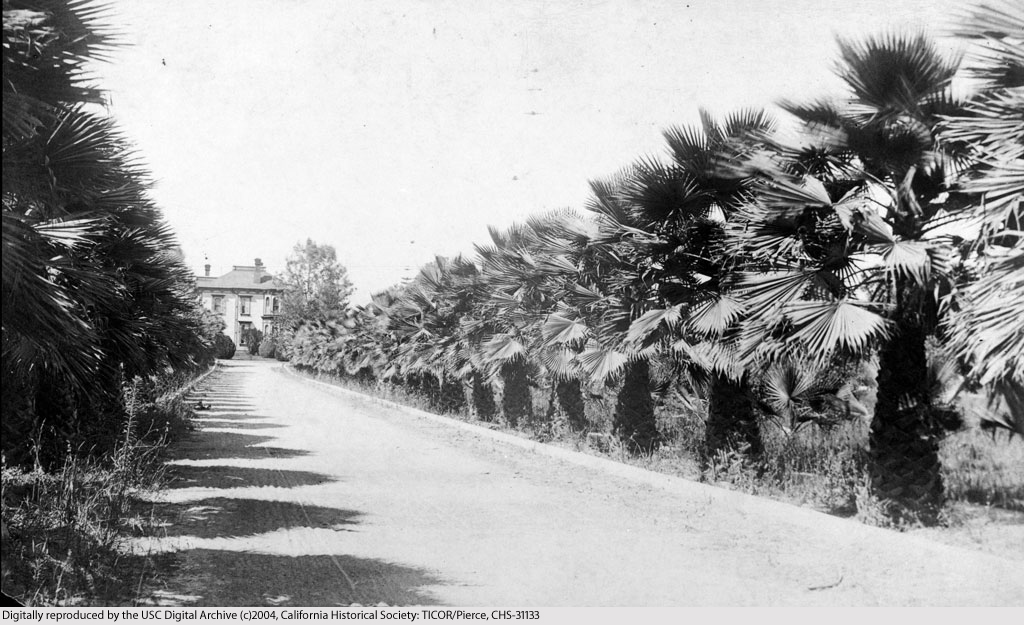

Courtesy U.S.C. Digital Library.


1886: More information about Longstreet and his estate: "From a letter to the Herald Express (1940 February 5): 'About 1875, Confederate General Longstreet acquired the 40 acres on the northeast corner of Figueroa and West Adams streets. He did what was possibly up to that time the most extensive grading job done in Los Angeles. He made a pleasing slope up to where the house was to be built, a slope such as we used to read about in southern love stories. He built a mansion of Southern grandeaur [sic] and elegance and made the entrance from West Adams, between the palms which he planted, a southern romance. He planted the whole place with orange trees and it became the showplace of Southern California...'."
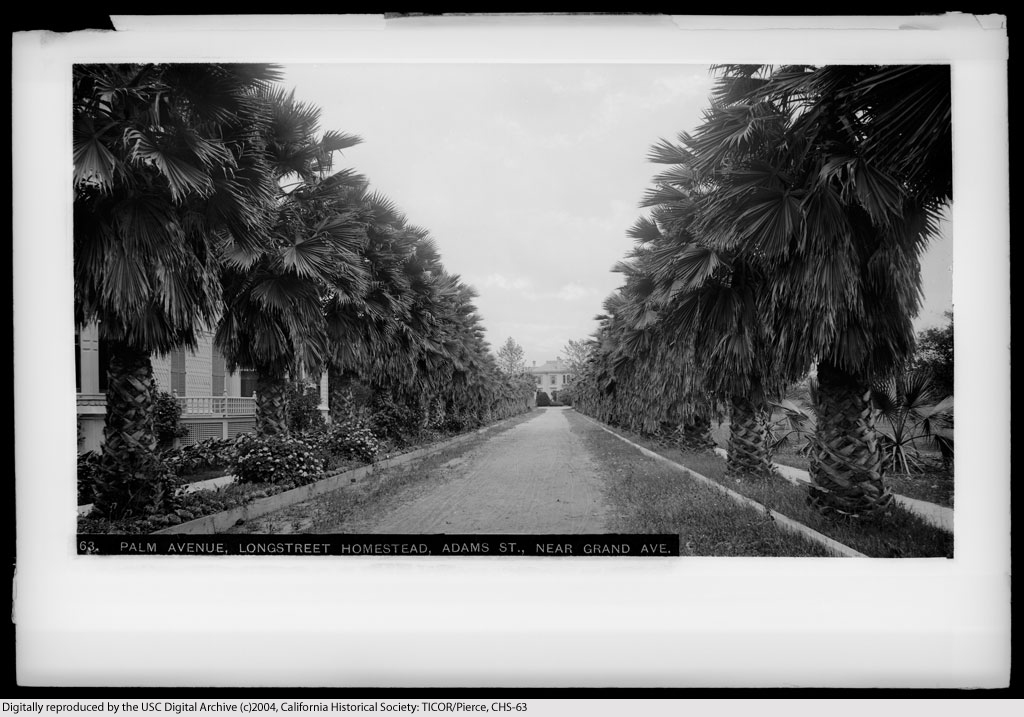

Courtesy U.S.C. Digital Library.


c.1900: This scene looks very similar to the photos of Palm Drive in the earliest 20th century postcards (e.g., as above), so even though this photo is undated, around 1900 seems about right. Here is a photo of General Longstreet's estate's grounds taken around 1890-1900. The caption mentions that the house at this time "was in use as an osteopathic hospital." The website for Orthopaedic Hospital says the clinic was founded in 1911, but evidently the property's history as a place for treating bone disorders extends back in time to the late 19th century when the property was still owned by Gen. Longstreet himself.
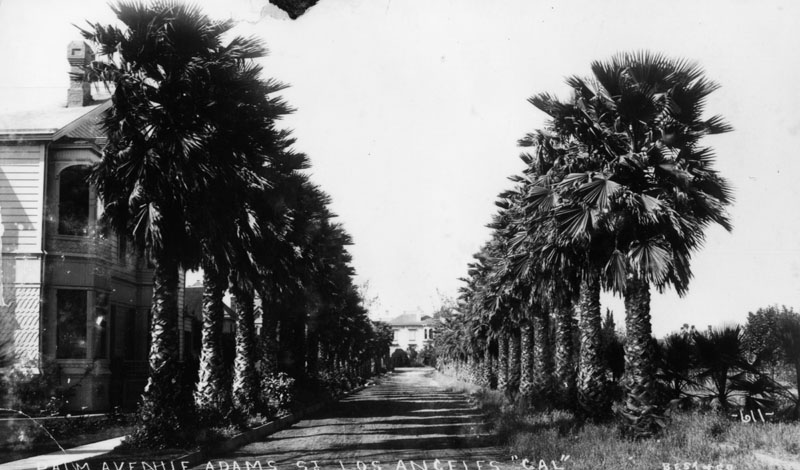

Courtesy Los Angeles Public Library.


c.1910: The referenced page says this photo was taken around 1920, but I guesstimate it was more likely taken closer to 1910.
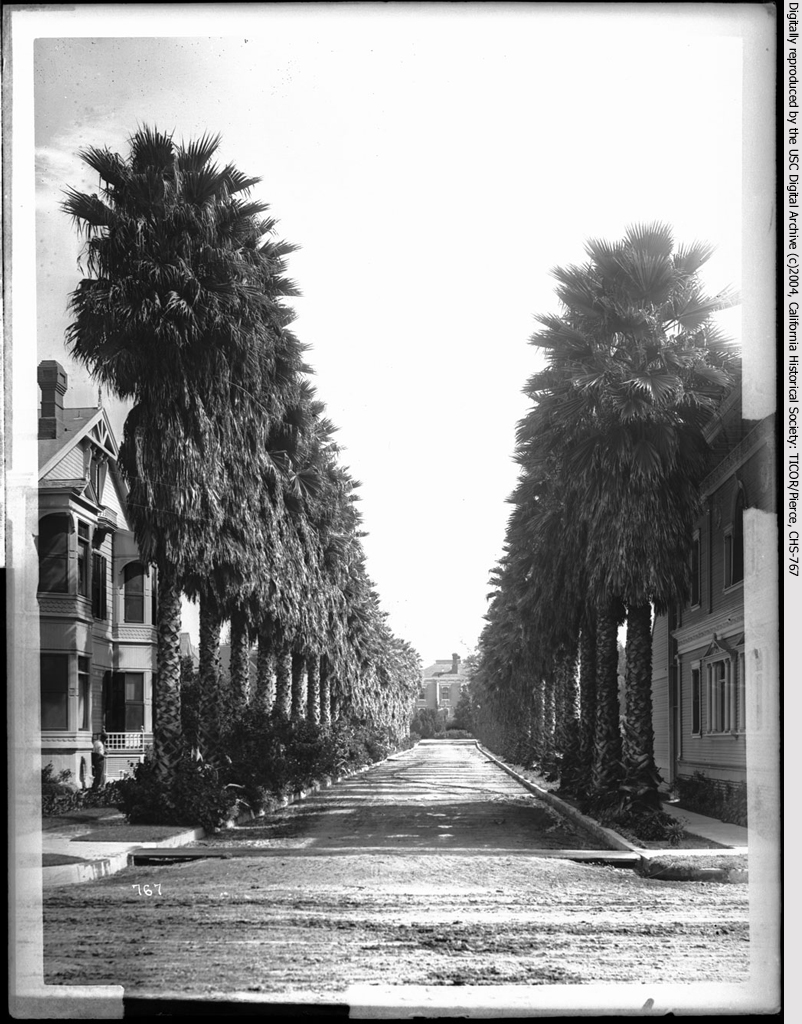

Courtesy U.S.C. Digital Library.


c.1920: The text accompanying this photo gives the account that, at the time, these were the "tallest palm[s] in the city." Aha! Logically, if these were the tallest, then they were also likely the oldest. The more famous palm-lined avenues of Beverly Hills were just being planted in the late 'teens/early '20s. The trees of Palm Drive were already about 60 years old by then.
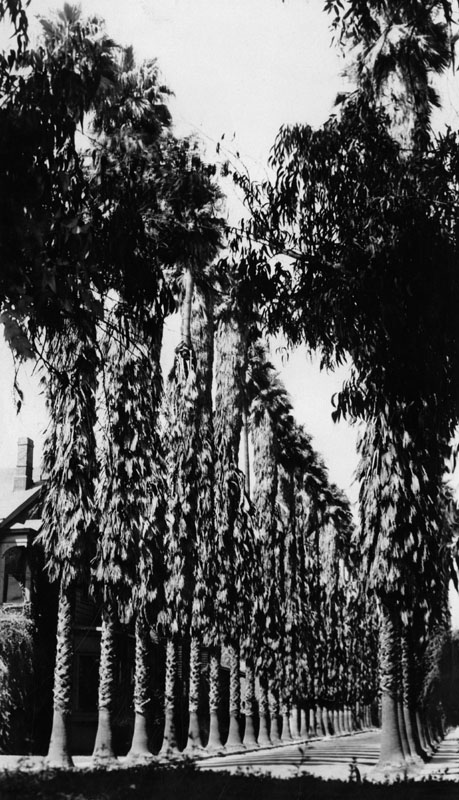

Courtesy Los Angeles Public Library.


c.1928: From the back cover of "La Reina - Los Angeles in Three Centuries," published by Security Trust & Savings Bank, 1929. The palms are truly in their prime! General Longstreet's house is gone now, and at right is the Holton Arms, an upscale West Adams "apartment hotel."
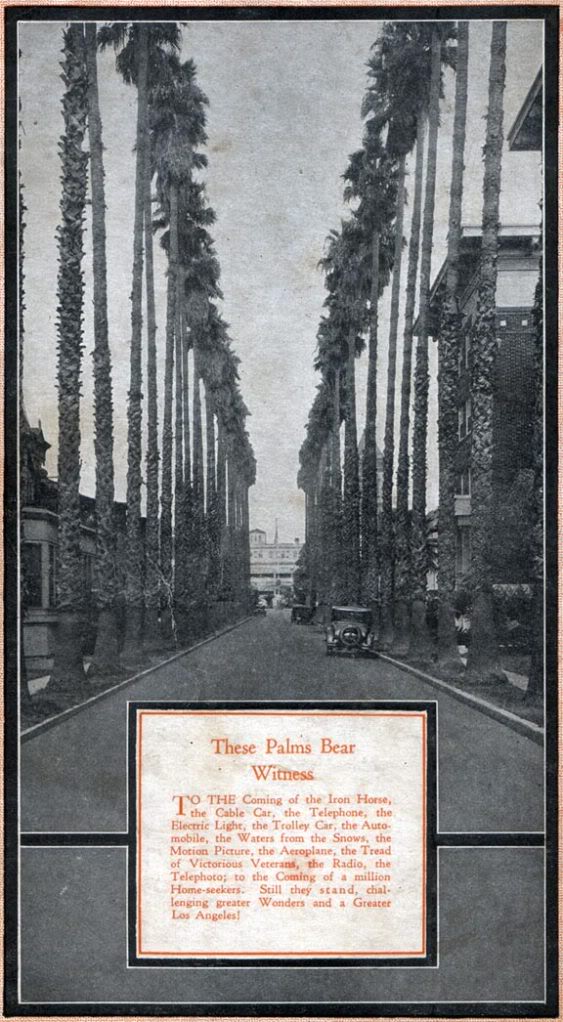


c.1940: This is the latest photo I was able find of the historical palms in the online archives. By this time, even before WWII, they had been here for 65 years, and were approximately 80 years old...
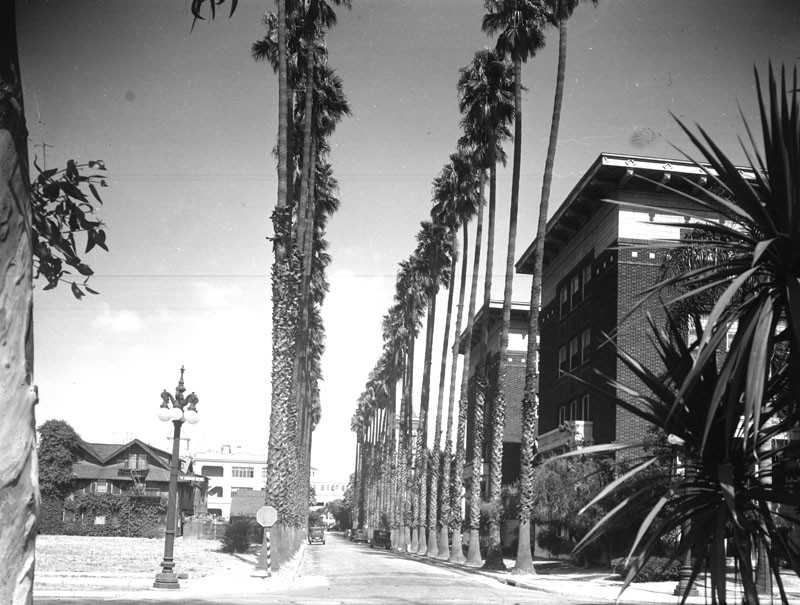

Courtesy Los Angeles Public Library.


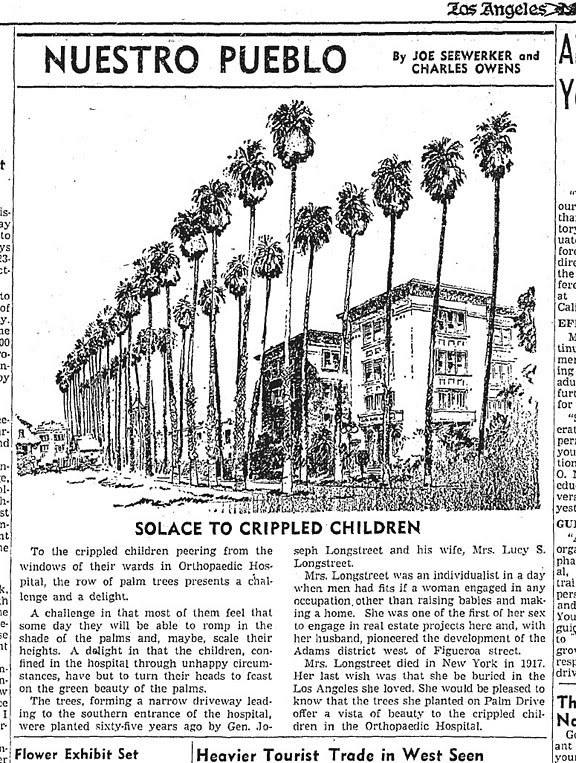
And it just so happened that while I was beginning to put the finishing touches on my information search, one of my favorite L.A. blogs (Larry Harnisch's The Daily Mirror) reprinted a column about General Longstreet's palm trees that had appeared in the Los Angeles Times 70 years ago, on July 8, 1938:


Click image for source.


Reading this old "Nuestro Pueblo" article was a big thrill, as it provided independent confirmation of many of the factoids I'd found in the USC and LAPL archives, with the happy inclusion of Mrs. Lucy Longstreet's role in the story.


On to the present day... via the web, I've learned that the site of Orthopaedic Hospital was sold in 2006, and that its redevelopment for luxury apartments commenced in 2007. According to this page, it appears at least some of the ancient palms have already been removed; perhaps all of them are gone now, I don't know. I don't live in the L.A. area, or I would definitely look into this myself.

It would truly be a shame to lose these venerable survivors. I wonder if anyone else but me has any idea just how old or significant these palms really are – that they were planted by a famous Confederate General and his wife, that they were once a celebrated showpiece of Los Angeles, and that today, they might just be the oldest living things in the entire city. Are Gen. Longstreet's palms really gone? I sincerely hope not...

Read the next installment in the saga of the Longstreet Palms: 'Whose palms are these, anyway?'
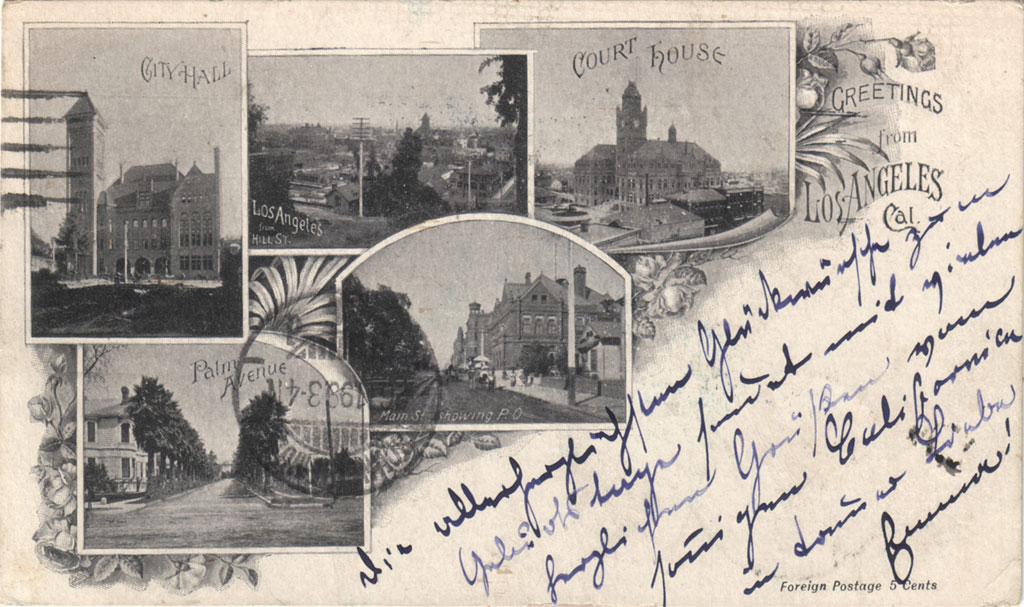


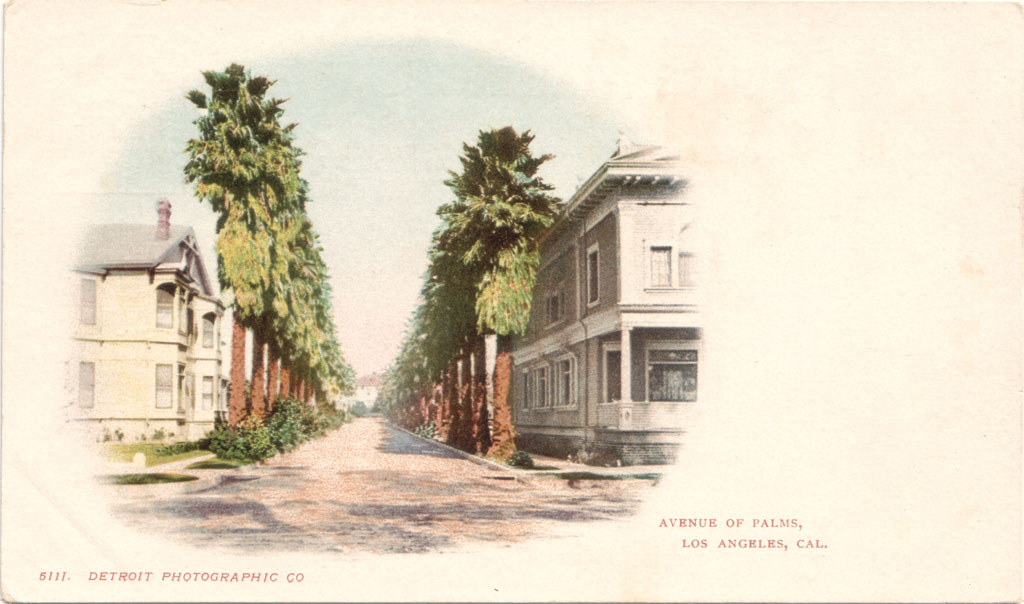
An 1899 postcard featuring "Palm Avenue."