A vanished city lives again...

Showing posts with label wilshire. Show all posts

Thursday, September 24, 2009

Historical map overlays at ucla.edu

[Note: the information in this post is obsolete.]

Recently, reader Gregg D'Albert wrote to tell me about the "hypercities" project at ucla.edu. This is an archive of historical maps of Los Angeles city and county that you can view in their original form, and also view as overlays on today's Google maps. Got a few minutes to explore a little? Whenever you're ready, begin by opening the URL below into a new browser tab or window:

http://linuxdev.ats.ucla.edu/#item_type=collection&item_id=8835

The site does have some limitations. For one thing, it can't be used with Internet Explorer. The interface is also a bit confusing at first. Here's how to view the maps and overlays.

First, go to the upper right of the map, and change the view from Satellite to Map. While you're up there, click the X box in the upper right of the sidebar to reveal the map selection menu.

Next, click the green button at upper left. Then, browse the available maps in the sidebar. Mouseovers of each menu item show the area covered by that map.

My favorite one to start out with is the 1898 "Official Map of the County of Los Angeles California." Click on that item in the sidebar, then wait for the map to load at left. (This can take awhile if you have slow DSL like I do.)

Now notice that there is a slide control inside the map's sidebar item. Move that back and forth to adjust the transparency of the historical level.

With the 1898 map, though, I recommend first just inspecting it as is for awhile. Zoom in there for a close look (remember to be patient as the historical map loads). The details are really fascinating! Find where you live now and see it as it was just over 100 years ago, and be amazed at the changes that have occurred here in the span of only 1-1/2 lifetimes...

Another one that's fun to explore is the 1897 Maxwell's City Directory street map. See Wilshire Boulevard when it was only 4 blocks long!
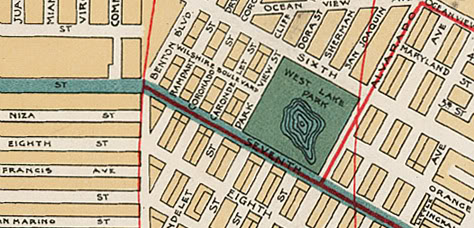

From 1897: The new Wilshire Boulevard at upper center (ats.ucla.edu).


Here, also, are two much better overlay "then and now" maps of the streets of Downtown than I presented in this post.
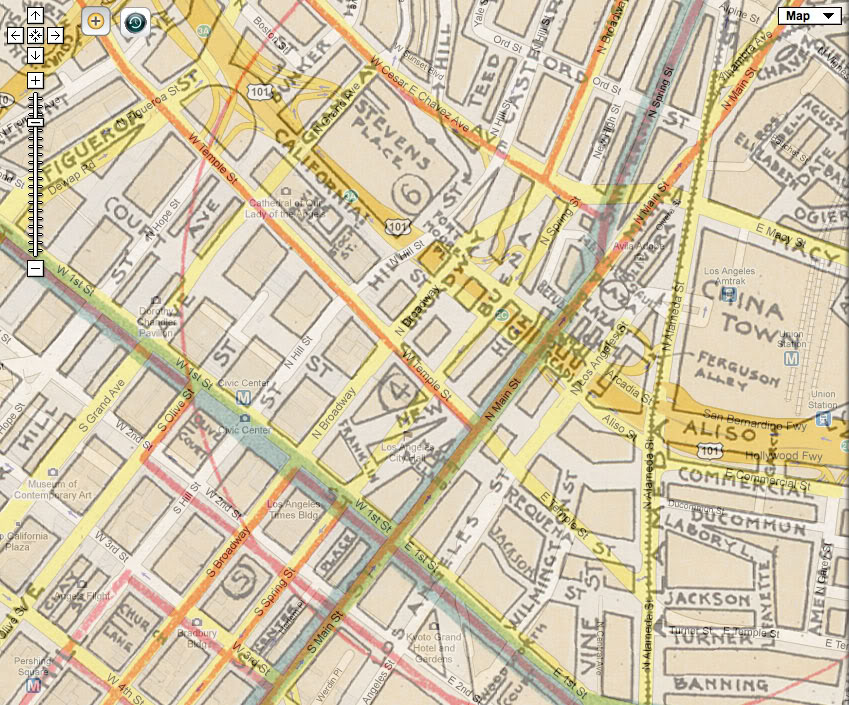
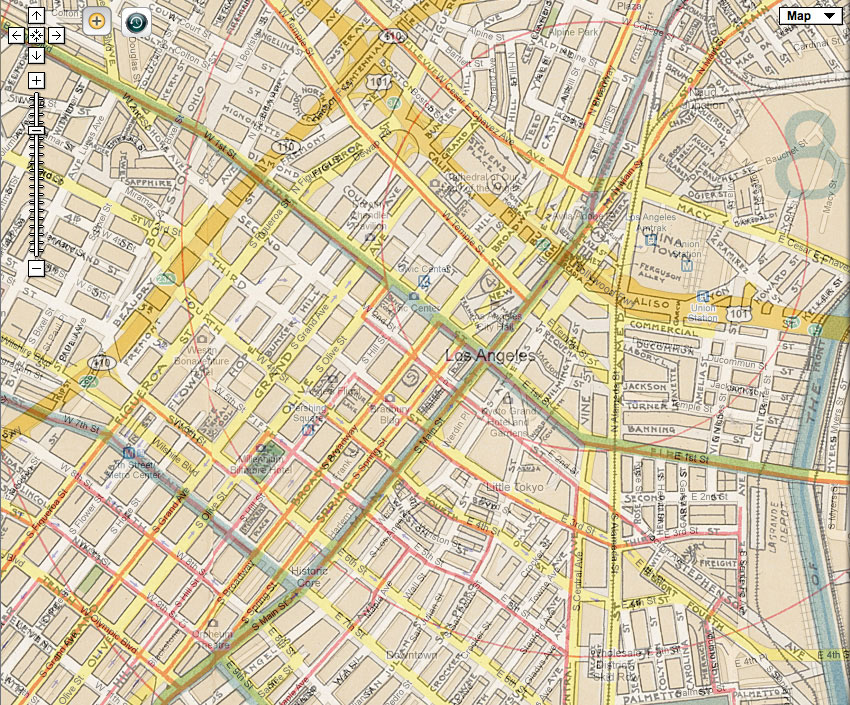


I hope the folks at ats.ucla.edu won't mind me reproducing this small portion of its wealth of old maps! That hypercities site really is quite addictive, I must say.
 

Thursday, May 7, 2009

Western and Wilshire in 1925

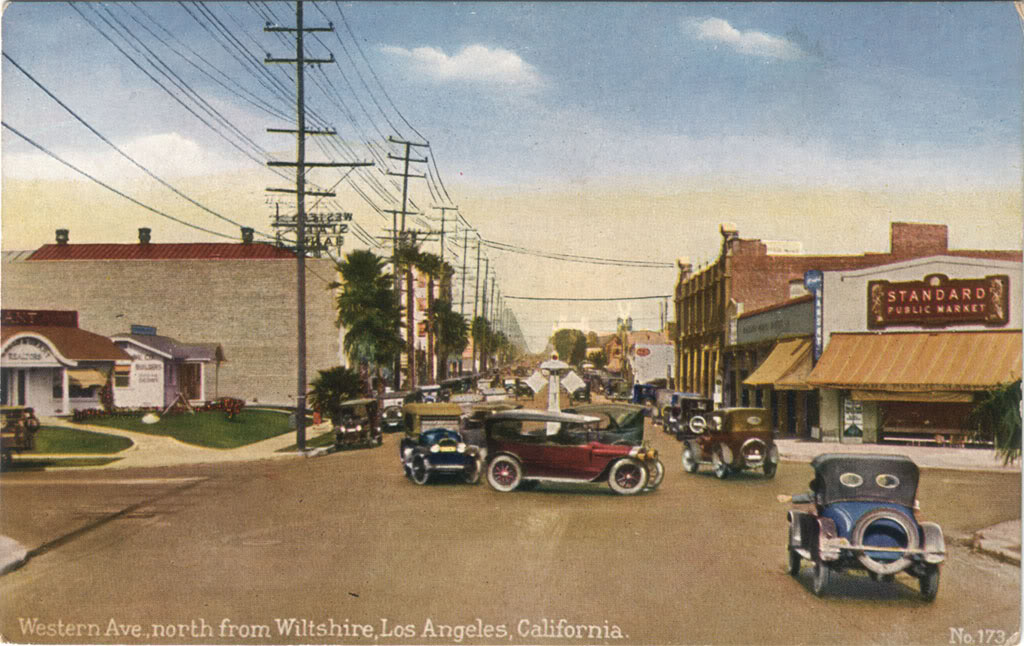
Got this old postcard via eBay the other day. It shows Western Avenue from its intersection with "Wiltshire" Boulevard, from around 1925. I bought it almost as an afterthought, but having it in hand and looking closely at it, I've found it to be quite interesting.


First, just to get our bearings, the street corner at lower right by the blue car is where the Wiltern Theatre would be built about half-a-decade later. Today, across Wilshire, where the Standard Public Market is in the postcard, stands the new Solair residential and retail center. The neighborhood's changed quite a bit since 1925, hasn't it!

What really intrigues me in the postcard image is the traffic control device in the center of the intersection. Anyone know what that gizmo's called? It appears to have just a single red light, or maybe it's merely a red reflector, so it's not really a traffic signal as we know them. Also, look how the cars are bunched around it. It's almost like the sign is a marker for a place where autos are supposed to turn; sort of like a modern roundabout. Notice how the driver of that blue car is signaling for a left turn, but he's over near the right side of the road. I don't know – I've never seen this kind of traffic control before. Anyone else got any ideas, or maybe know the actual story behind this device?


Monday, June 23, 2008

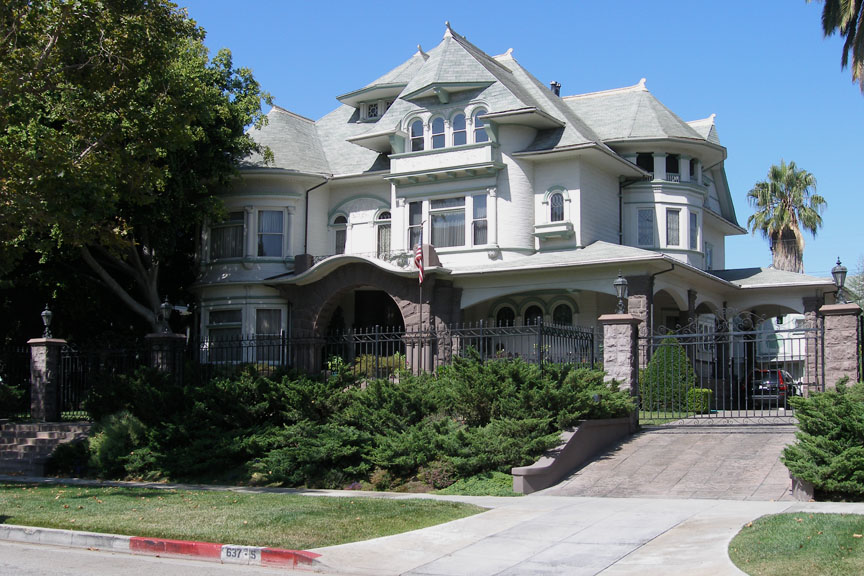
Rediscovering the "Willard" house

When I was a teenager, one of my favorite movies was the original Willard (1971), which was about a young man who befriended some rats that lived in and around his house. I liked the movie because I had so much in common with the protagonist, Willard Stiles. Willard was the son of a steel-industry man; so was I. Willard's mother was domineering and sickly, and demanded complete devotion. So did mine. Willard's working life was made a living hell by his duplicitous general manager and harassing co-workers. Mine, too. And, as I did, Willard turned to the companionship of animals as a psychic refuge from his tortured daily existence.

Fast forward ten years. I was working for my father's company at the time, and I had a business appointment in the Wilshire district across town. That office turned out to be in a grand old Victorian mansion, the likes of which were rarely seen anymore, especially right off Wilshire Boulevard, which was one of the most heavily developed (and re-developed) streets in West Los Angeles in the mid-20th century.

Anyway, I trotted up the front steps, opened up the huge carved wooden door, and stepped inside. Right away I saw it wasn't just one office, but many. I walked through the main hall seeing a large parlor then a large dining room to my left. To my right was a grand staircase. Then, as I spotted the office I was looking for at the end of the entry hall, it struck me.

I've been here before.

But no, no way. I'd never been in this house, obviously. But that front room, the room next to it, that staircase. Wow! This is the Willard house! Talk about a chill running up my spine! I was completely dumbstruck. I walked through a doorway on the far side of the main room, and there, again, to my right was another staircase – Willard's mother's staircase, the one in the movie that had the invalid's escalator chair on it. And the office my appointment was in was in the former kitchen, where Willard prepared the poison for Ben and the rest of the rats!

This was almost too much.

As soon as I introduced myself to my business associate, I asked, "Is this the house where they filmed Willard? "Yes! How did you know that?" "I just walked in and I recognized it from the movie." Then I looked out the back windows, and there was the overgrown garden and the cement pond, again, just like it was in the film.

(As an aside, there was another memorable thing about that office. It was the first time I ever saw a computer used in a work environment – and it was an Apple II, of course. ^^)

Anyway, in July, 2009, I got to see the old mansion again, though only from the outside. Oh well, I'm quite content with my memories as they are. Nothing could re-create the surprise of that initial visit!


The Higgins-Verbeck-Hirsch mansion, 637 S. Lucerne Blvd., Los Angeles. Photo by J Scott Shannon.