A vanished city lives again...

Showing posts with label nostalgia. Show all posts

Thursday, September 15, 2011

My first (and last) ride on the Red Car

Back in 1961, my mom took me on one of the last Pacific Electric trolley runs down to Long Beach – a train ride exactly like the one depicted in this film. Although I was only 6 at the time, I still have some very clear memories of that day-trip, half-a-century ago. Looking back now, I realize that this was my first-ever excursion into Los Angeles past.


One morning at breakfast (I think it was actually a school day), Mom just told me out-of-the-blue that we were going Downtown to ride the last of the street cars. She wanted me to experience something that was an important part of her daily life when she was young; something that was now about to vanish into history.

Before we rode the Red Car, though, we went to Angels Flight. That was the first of the two times I got to ride it, and it was a big thrill. Afterward, we stood at a busy street corner for awhile – it was probably Third and Hill – waiting for a bus to take us to the PE station. I'll never forget the NOISE of that intersection; how LOUD the general hustle-and-bustle of the city was. It was nothing like out in the suburbs. I was especially impressed by the electric arcs and sparks that shot out from the trolleys' contact with the overhead wires. Snap! Crackle! Pop!

The Red Car ride to Long Beach was actually pretty boring for a fidgety 6-year-old, despite it being my first time ever on an inter-urban train. I do remember the car was filled to capacity. I guess nostalgia was thick among the passengers, as there was little talking. Mostly just the sound of the train wheels going clickity-clack, clickity-clack, all along the rail road track.

When we got to Long Beach, Mom took me to an immense old cafeteria downtown. The ceiling seemed like it was two stories high. It was crowded and noisy, and kind of dark inside, even though it was mid-day. I can't recall the name of the big cafeteria, but I think my mom probably went there a lot when she had relatives living in Long Beach in the '40s.

I don't remember the ride back at all. Likely I slept all the way. But overall, it was a very memorable day! I think Mom would be surprised how much I remember. At the time, she probably concluded that the experience was wasted on a little child like me, but it turned out it wasn't at all. I really wish I could tell her now how much it meant to me, and thank her accordingly.

I'm really struck by how ancient and worn this film looks. Knowing I was on one of those trains, well, it makes ME feel old, too. I have to say, though, that I am in much better shape after 50 years than this footage is! That's at least some consolation for a man my age. :-)


Wednesday, March 2, 2011

Mom's first car at the Silver Lake Auto Court

Mother's new position as General Secretary of the Los Angeles Civic Light Opera was apparently sufficiently remunerative for her to be able to buy her first car. It was a used 1936 Pontiac Master Six Coupe. Here she is with her new Pride and Joy at the Silver Lake Auto Court at 2500 Glendale Blvd. in July, 1938.


Link to original photo on Flickr.


I know Mom did not live there, though. In 1938, she and her sister were living in their first apartment at the Barker Hotel in Westlake.

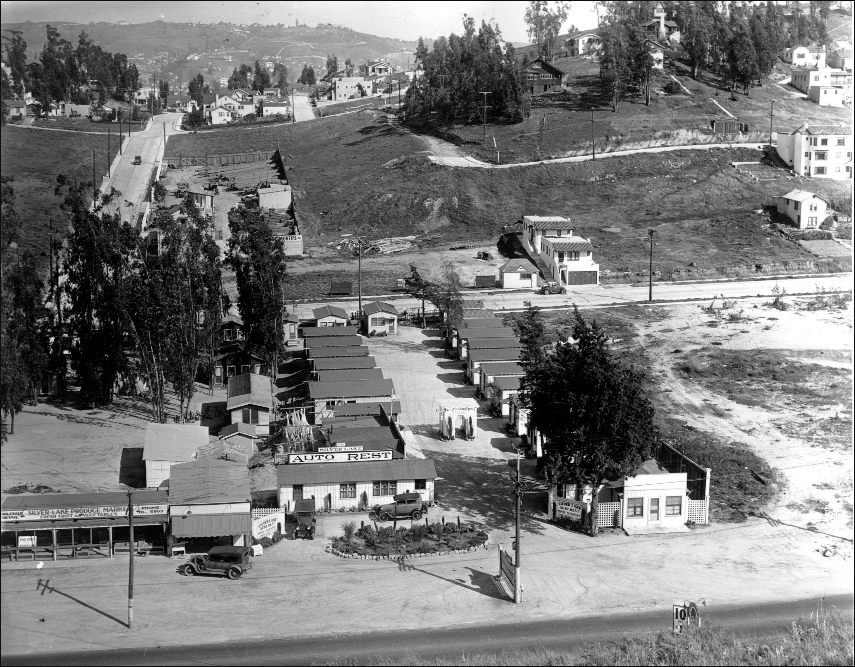
Here is a contemporaneous linen postcard of the auto rest.


On the reverse of the card it states: "A 67 unit Auto Court with Trailer Sites. Resort Atmosphere in the heart of the City, well known for its Hospitality and Service. Rates Most Reasonable."

Here is an aerial view. As best as I'm able to determine, Mom was posing with her car near the spot where the red arrow is pointing.


silverlake.org


Remarkably, Michael Smith, a/k/a Kansas Sebastian on flickr, posted this Then & Now composite of the Silver Lake Auto Court in the 1920s with a comparison shot from 2010. His sleuthing revealed that the older aerial view was taken approximately 11 years before Mother was there posing with her Pontiac.


Click image to view the original photo on Flickr.


Amazing the things one can find on the 'net, eh!


Friday, December 25, 2009

The Madame of the Opera

I told you all that I had something special in the works. Well, here it is at long last – a Christmas present to my late mother...

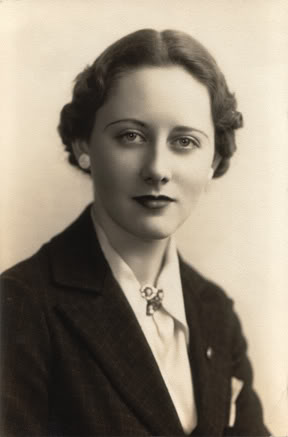
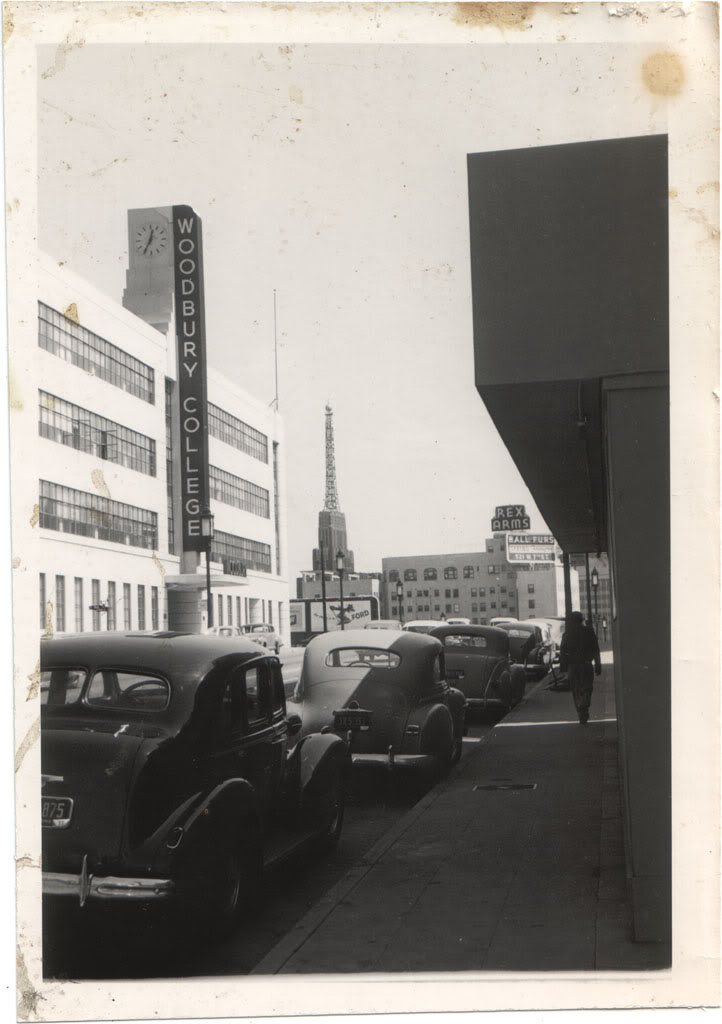
One of the prime reasons I'm so interested in Los Angeles history is that my mom lived and worked in the city from 1934-1951. She moved there immediately after high school to attend Woodbury College, from which she graduated with her secretarial degree at the top of her class in 1936 at the ripe old age of 18. This was her Woodbury's senior class portrait.


Link to original photo on Flickr.


Mom started out big in the L.A. business world, securing her first position at the Huntington Land Company. She didn't stay there long, though. The following year, her dream job came her way, when she became the first General Secretary of the newly-founded Los Angeles Civic Light Opera Association, working directly under its founder, impresario Edwin Lester.

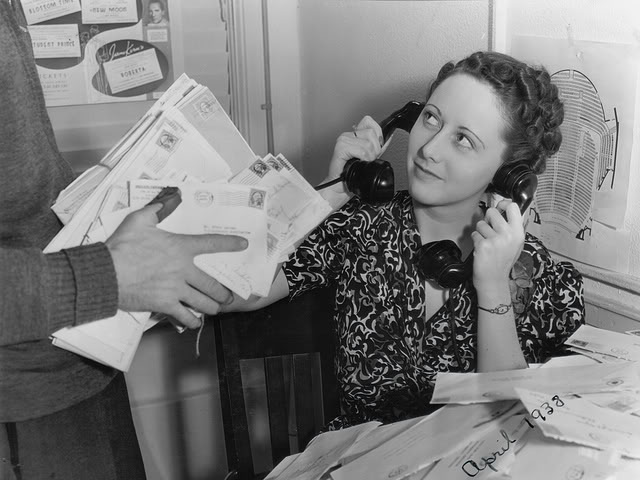
Here she is in her office in The Auditorium in April, 1938, dealing with Ed Lester's daily mountain of mail.


Link to original photo on Flickr.


(N.b., behind her head is the seating chart for Philharmonic Auditorium. To see it in greater detail, follow the flickr page link directly above and click on the Download icon and select 'View all sizes' for a high-res enlargement.)

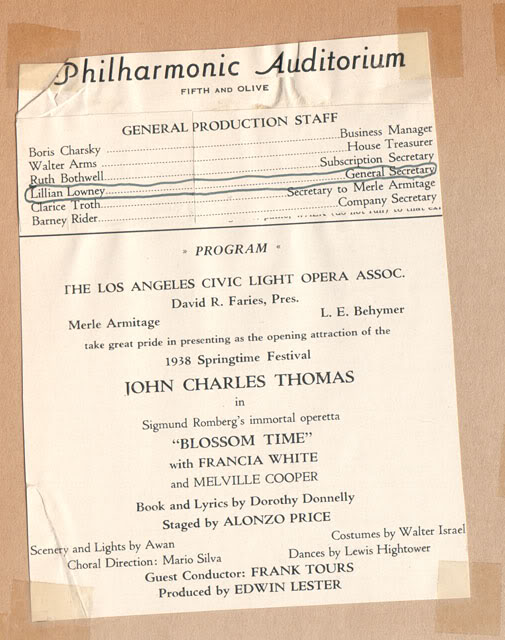
The very first production of the LACLO was a musical adaptation of the life of classical composer Franz Schubert called "Blossom Time." Here's Mom's listing in the play's credits.


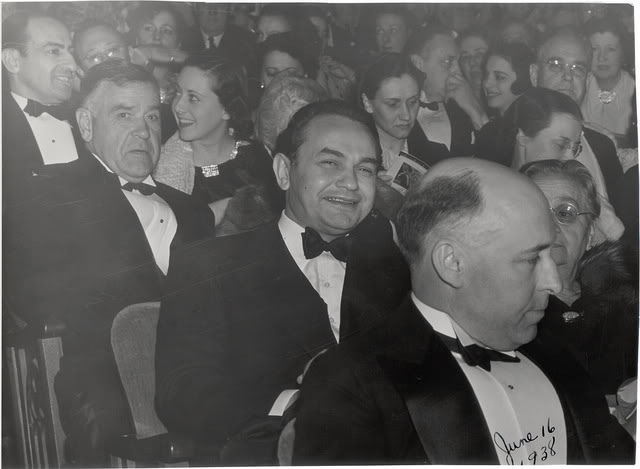
And here is a photo from the opening night of Blossom Time at Philharmonic Auditorium, June 16, 1938. Dead center is the world-famous actor Edward G. Robinson. Two rows back and to the right, the man picking his nose is none other than John Barrymore, and next to him is his wife, Elaine Barrie. At far upper left is Edwin Lester himself. And who is that smiling woman next to him? Ed Lester's date on his triumphal opening night was my very own mom!


Link to original photo on Flickr.


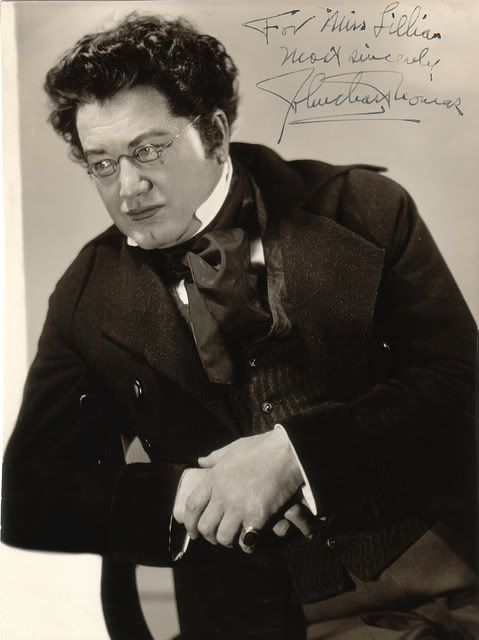
During the operetta's rehearsals, Mother became good friends with the star of Blossom Time: the famed opera baritone John Charles Thomas, who played Schubert in the LACLO production.


Link to original photo on Flickr.


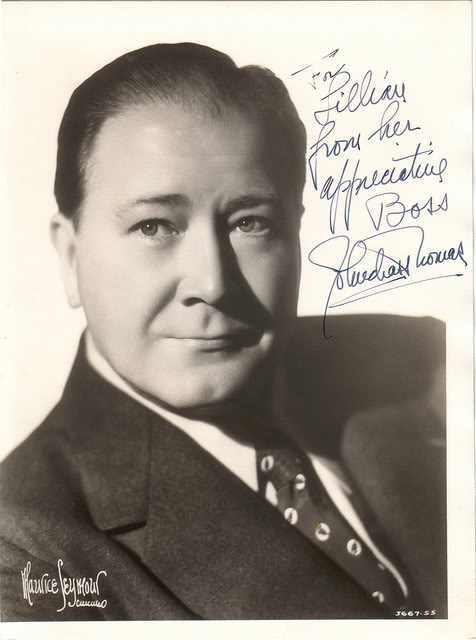
Later, from 1942-1946, Mother would become J.C.T.'s private secretary during the singer's wartime years in Hollywood with the Westinghouse Radio Players.


Link to original photo on Flickr.


Mother remained lifelong friends with both John Charles Thomas and Edwin Lester. Mom had reserved 5th row center seats at every LACLO production for life, courtesy of Mr. Lester. He acknowledged that he couldn't have gotten LACLO off the ground were it not for my mom's assistance back in 1938. Lillian Lowney was, indeed, the original Madame of Los Angeles's Civic Light Opera! I'm proud that my mom had this bit part in L.A.'s musical/cultural history, and I'm glad I've finally gotten the opportunity to tell her story here.


Thursday, July 30, 2009

Where Mother was: Then & Now

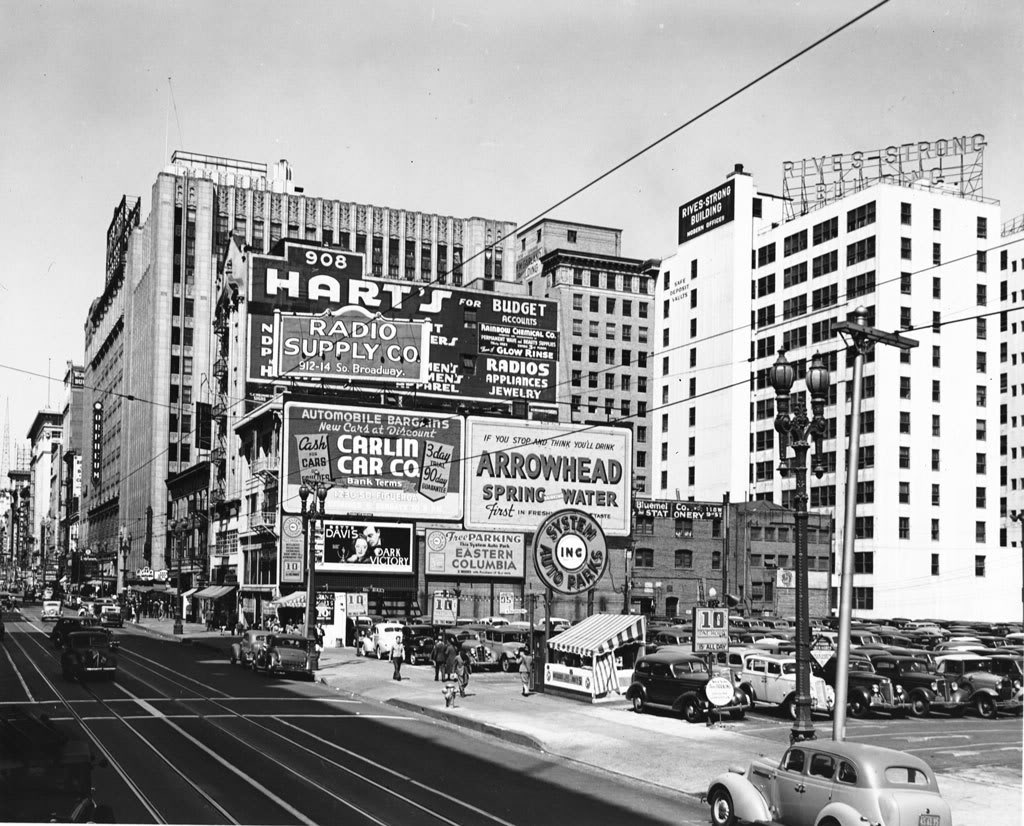
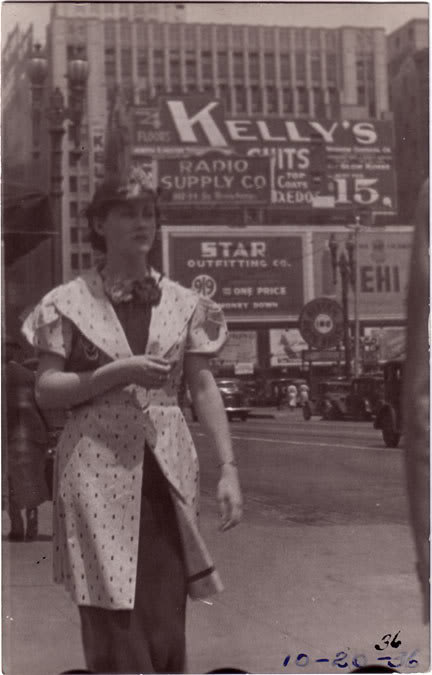
In this old post, I told the story of my mother having had her picture taken by a street photographer somewhere in downtown Los Angeles in 1936, when she was a 19-year-old secretary for the Huntington Land Company. Some time later, I finally identified the location of the picture as having been the 900 block of South Broadway. Here's a nice clear photo of the locale in 1939.


USC Digital Library-Dick Whittington Photography Collection.


Anyway, thereafter, I decided that if I ever went back to Los Angeles, I would like to visit the place where my mother was photographed, 73 years ago. And three Wednesdays ago, during my recent L.A. vacation, I did just that.

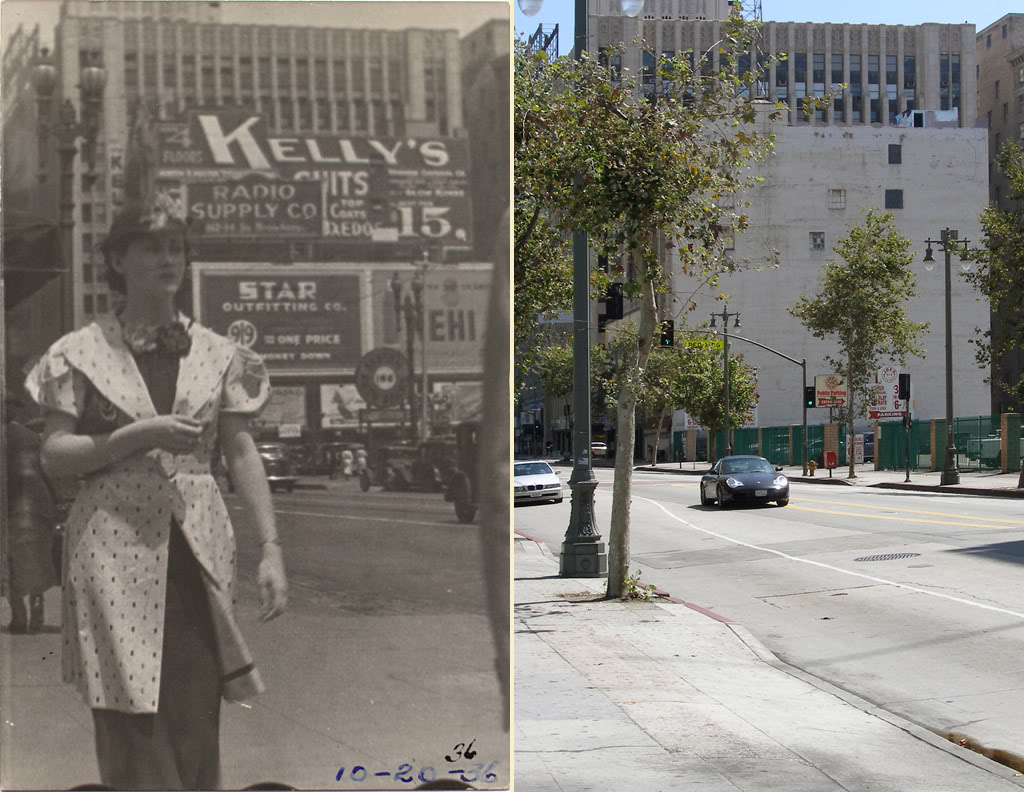
Here's the exact spot, then and now.


J Scott Shannon.


Remarkably, relatively little in the background has changed in the intervening seven decades. The two principal buildings visible in the old photograph are still there – the 9th and Broadway Building (1929), and the L.L. Burns Building (1914); the latter is the one with the "Kelly's" ad painted on its side. (No ads today – this section of Broadway is not in any way the commercial hotspot it used to be.) The lampposts are noticeably different in height and style, but the bases themselves are apparently the same ones as when Mother was there.


Photo by J Scott Shannon.


And where was Mom walking to that day in October, 1936? Probably to a trolley stop at the intersection of South Broadway and Olympic Blvd., which is only a few feet in back of where the 1936 photographer was standing.

Heh, it's funny, when I was there last week, I tried to show Mom's picture to several passers-by, but nobody could be bothered. Admittedly, if I were walking on South Broadway and some stranger asked if I'd like to see a picture of his mother, I'd probably avoid the guy, too. ;-)


Monday, June 8, 2009

Louis Phillips at Spadra Cemetery

Louis Phillips was an important figure in late 19th century Los Angeles. He's perhaps best known as the developer of the elegant Phillips Block (1887-1912), formerly located at Spring and Franklin Streets.

Although influential in the commercial life of Los Angeles, Louis Phillips did not reside in the city itself. He lived on his land holdings in Spadra, on Rancho San Jose in eastern Los Angeles County. In 1875, Phillips built a mansion at Spadra, and there he dwelt for the rest of his life. When he died in 1900, Phillips was interred at nearby Spadra Cemetery.


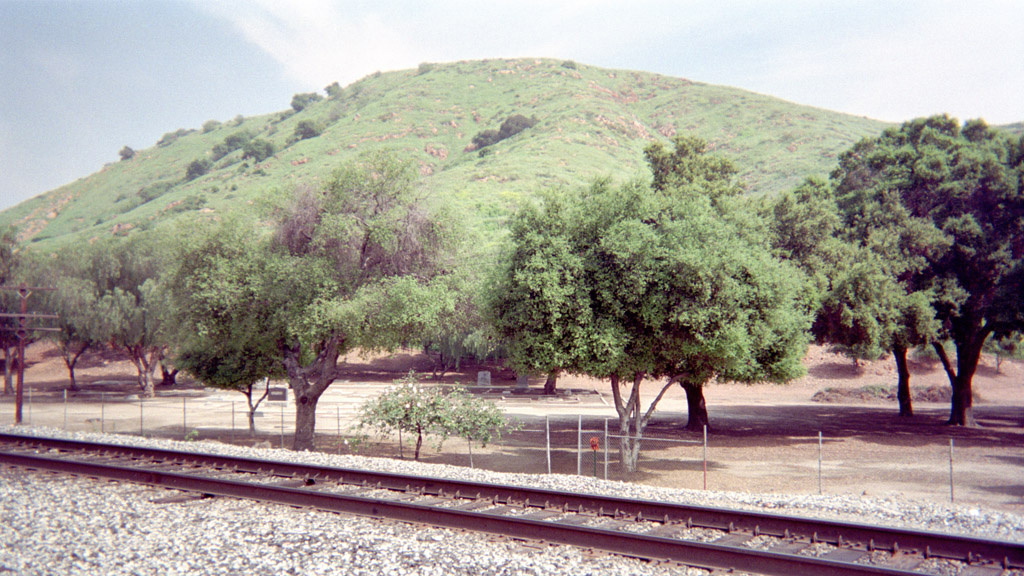
Now for a personal connection. It turns out that I knew about the pioneer Phillips family decades before I became an L.A. history buff. It just so happens that, in the 1920s, my father went to school in nearby Pomona with one of Louis Phillips's descendants. One of the few stories Dad used to tell about his childhood was how he got a bad case of poison oak while he and the Phillips boy were hiking up on Elephant Hill, which overlooked the old family mansion...and Spadra Cemetery.


Spadra Cemetery and Elephant Hill, Pomona, California, March 19, 1998. Photo by J Scott Shannon.


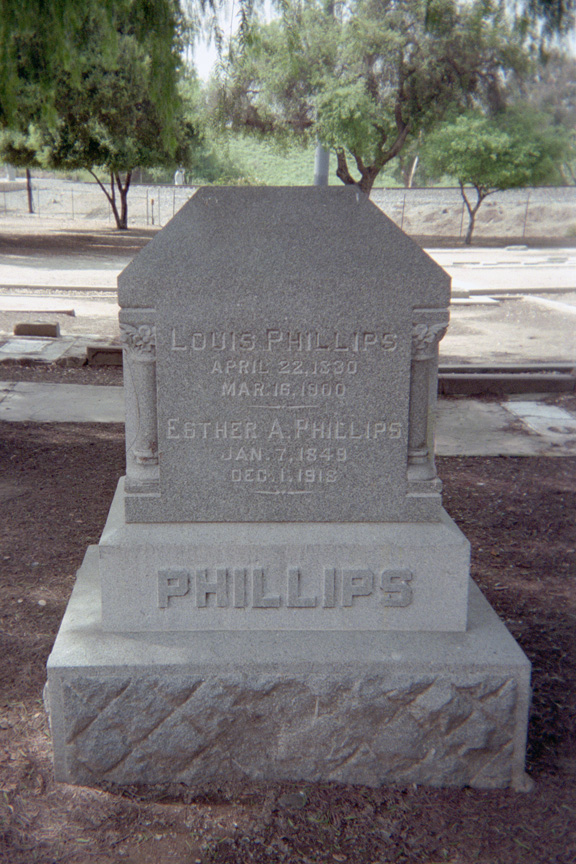
I'd known about this old settlers burial ground myself since the 57 freeway was built in the early 1970s; it could be clearly seen from the northbound viaduct as it came down from Diamond Bar. I was intrigued by the place, but I never actually visited the cemetery until 1998. When I did, I was pleased to discover the Phillips family plot there, and I took this photo of the marble monument.


Photo by J Scott Shannon.


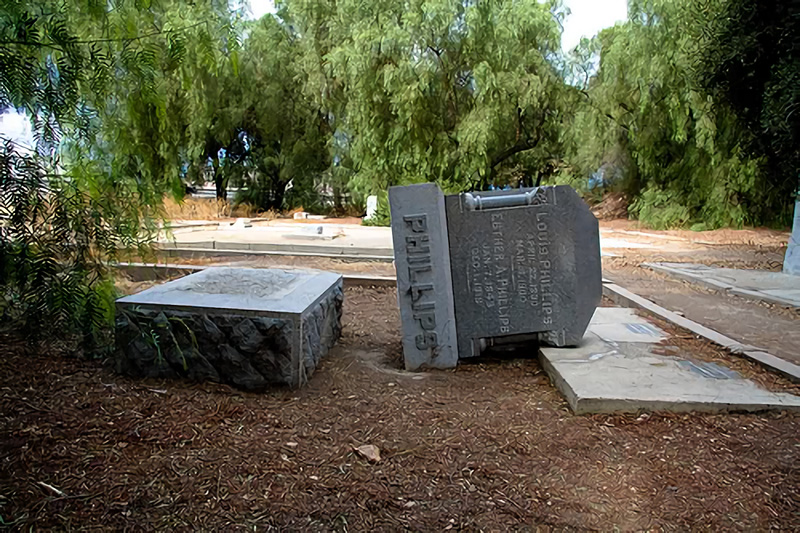
While researching this post, however, I was shocked to learn that Phillips's gravestone had more recently been vandalized.


Photo by rwpeary on Flickr.

Bastards! This sort of thing genuinely sickens me...


Monday, June 1, 2009

Downtown Harbor Freeway, 50 years ago


Photo above and others linked to in this post courtesy of the U.S.C. Digital Archive.

Today, this is the downtown section of the Pasadena Freeway (Interstate 110). In 1959, though, when this photo was taken, it was the northernmost section of the Harbor Freeway (California State Highway 11), and this is how I first remember it.

I like this photo primarily for its composition, but also because it gives a great close-up view of what an old L.A. freeway looked like. Mom hated the Harbor Freeway, though, so we rarely took this route, but I still have vivid recollections of the eastern San Bernardino Freeway (U.S. 99 then/I-10 now) in the late '50s, and our hometown stretch looked exactly like this (minus the fancy planters in the center divider).

The freeways were quite different back then. For one thing, all of the exit and informational signs on the original freeways were made of porcelain steel, and had white letters on a black background, like the one here that says "Downtown." The smaller informational signs at the roadside had reflectors in the letters so they could be read at night, but the large signs were illuminated by lights, much like a billboard. (Here's another view of the Downtown Harbor, showing some nice examples of the larger black-and-white signage.) The first time I remember seeing the green freeway signs of today was when the first stretch of the Santa Monica Freeway opened in 1961.

To me, though, the most remarkable feature of the early freeways was the complete absence of any kind of crash barrier in the median strip. This plus the fact that seat belts were still a relatively rare innovation in the 1950s – well, it's no wonder many people back then thought that driving on a freeway was literally taking your life in your hands. Note that the curb isn't even sharply angled to keep a tire from straying into the dividing strip. It's easy to imagine how someone in the fast lane could take their eyes off the road for only a second or two, drift to the left a few inches, then suddenly find themselves facing an imminent, fatal head-on collision. (Here is a photo of the Pasadena Freeway in 1958, showing a similar lack of any effective barrier in the median.)

The first built-in barrier I can recall was again on the new downtown Santa Monica in 1961, which had chain-link fencing in the center divider. (!!!) Oh yeah, I felt A LOT safer then! It was only after they started using chain-link, though, that you could see just how often cars strayed into the median (and how pathetic the chain-link was at preventing cross-overs). Really, that fencing looked like a war zone in places. And it must have been a genuine pain to repair, too, as the metal posts were seated directly into the asphalt of the center divide.

One thing about the freeways that's stayed the same over the last 50 years is the traffic congestion. Everything else in L.A. may change, but traffic jams there really are forever.


Monday, June 23, 2008

Rediscovering the "Willard" house

When I was a teenager, one of my favorite movies was the original Willard (1971), which was about a young man who befriended some rats that lived in and around his house. I liked the movie because I had so much in common with the protagonist, Willard Stiles. Willard was the son of a steel-industry man; so was I. Willard's mother was domineering and sickly, and demanded complete devotion. So did mine. Willard's working life was made a living hell by his duplicitous general manager and harassing co-workers. Mine, too. And, as I did, Willard turned to the companionship of animals as a psychic refuge from his tortured daily existence.

Fast forward ten years. I was working for my father's company at the time, and I had a business appointment in the Wilshire district across town. That office turned out to be in a grand old Victorian mansion, the likes of which were rarely seen anymore, especially right off Wilshire Boulevard, which was one of the most heavily developed (and re-developed) streets in West Los Angeles in the mid-20th century.

Anyway, I trotted up the front steps, opened up the huge carved wooden door, and stepped inside. Right away I saw it wasn't just one office, but many. I walked through the main hall seeing a large parlor then a large dining room to my left. To my right was a grand staircase. Then, as I spotted the office I was looking for at the end of the entry hall, it struck me.

I've been here before.

But no, no way. I'd never been in this house, obviously. But that front room, the room next to it, that staircase. Wow! This is the Willard house! Talk about a chill running up my spine! I was completely dumbstruck. I walked through a doorway on the far side of the main room, and there, again, to my right was another staircase – Willard's mother's staircase, the one in the movie that had the invalid's escalator chair on it. And the office my appointment was in was in the former kitchen, where Willard prepared the poison for Ben and the rest of the rats!

This was almost too much.

As soon as I introduced myself to my business associate, I asked, "Is this the house where they filmed Willard? "Yes! How did you know that?" "I just walked in and I recognized it from the movie." Then I looked out the back windows, and there was the overgrown garden and the cement pond, again, just like it was in the film.

(As an aside, there was another memorable thing about that office. It was the first time I ever saw a computer used in a work environment – and it was an Apple II, of course. ^^)

Anyway, in July, 2009, I got to see the old mansion again, though only from the outside. Oh well, I'm quite content with my memories as they are. Nothing could re-create the surprise of that initial visit!


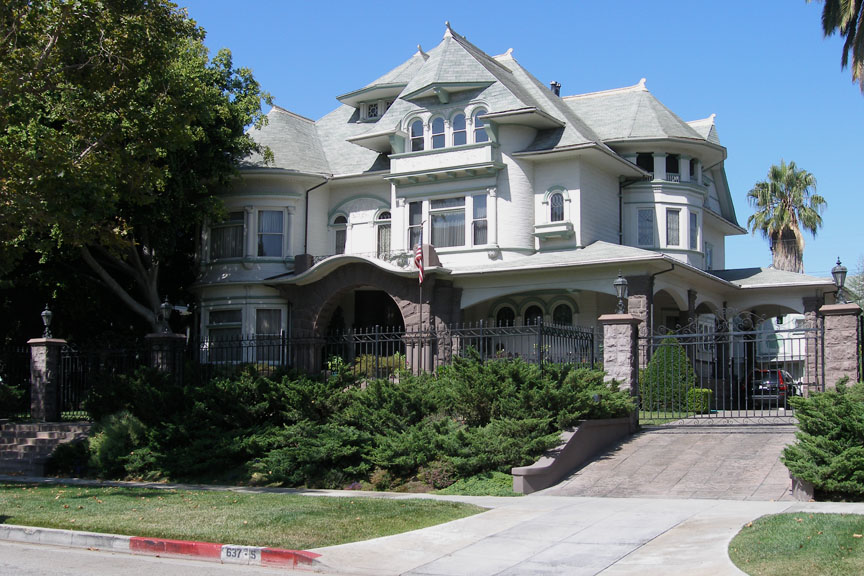
The Higgins-Verbeck-Hirsch mansion, 637 S. Lucerne Blvd., Los Angeles. Photo by J Scott Shannon.


Thursday, May 29, 2008

Third Street at Hill: Then, Then, Then and Now

Within a span of only two lifetimes, one street intersection in Los Angeles undergoes an almost unimaginable series of transformations...

c.1890:


Courtesy U.S.C. Digital Library.

c.1935:


Courtesy Los Angeles Public Library.

1978:


Photo by William Reagh, Courtesy California State Library.

Today:


Photo by J Scott Shannon.


Sunday, February 17, 2008

The Bradbury Building


Photo by J Scott Shannon.


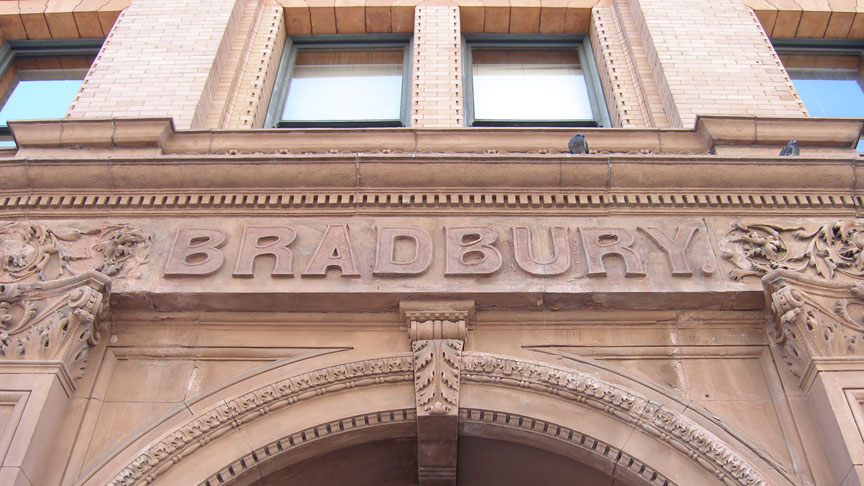
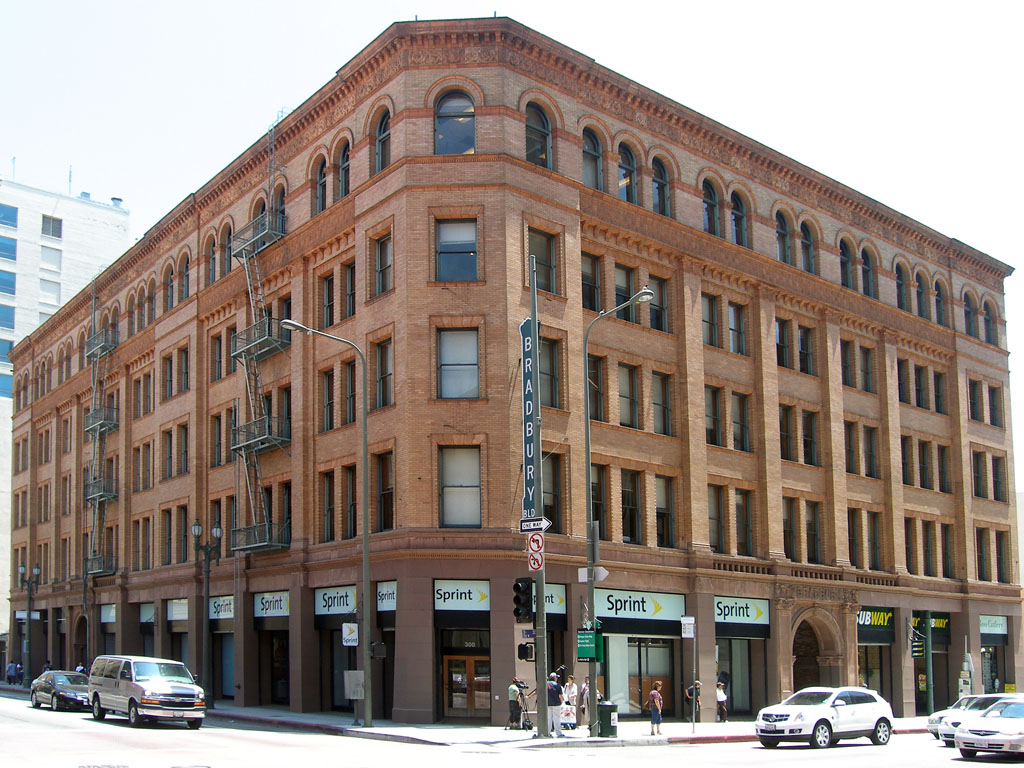
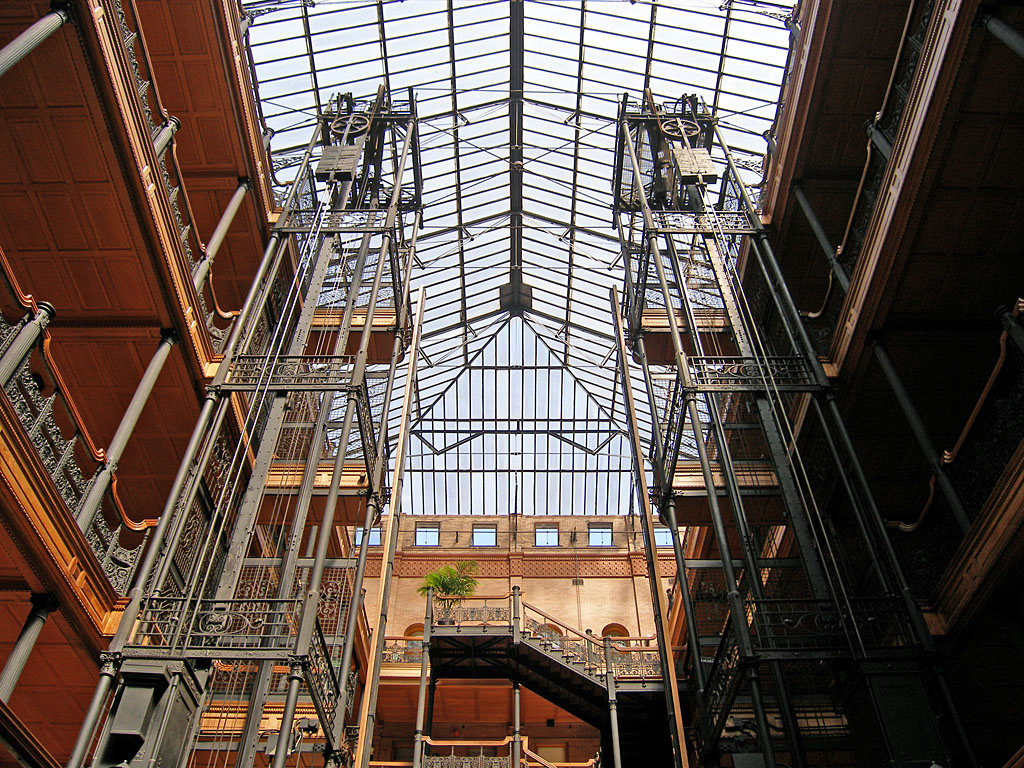
Right after you got your driver's license, where was the very first place you drove to on your own? Do you remember? I sure do! As soon as I could talk my dad into loaning me his car for a day, of all places, I went here – to the Bradbury Building, at 304 S. Broadway in Los Angeles. I couldn't wait to see this place with my own eyes. I was 16 years old then, and the Bradbury Building was, at least in an architectural sense, my first love...


Photo by J Scott Shannon.

I'd learned about the Bradbury Building via a favorite TV show called "Ralph Story's Los Angeles," and what I saw really struck a chord in me. For starters, I could hardly believe such an old building still existed in Los Angeles (it was built in 1889-1893). I'd grown up in the L.A. area and I never heard of the place before, and neither had my parents, both of whom had lived most of their lives in the southland.

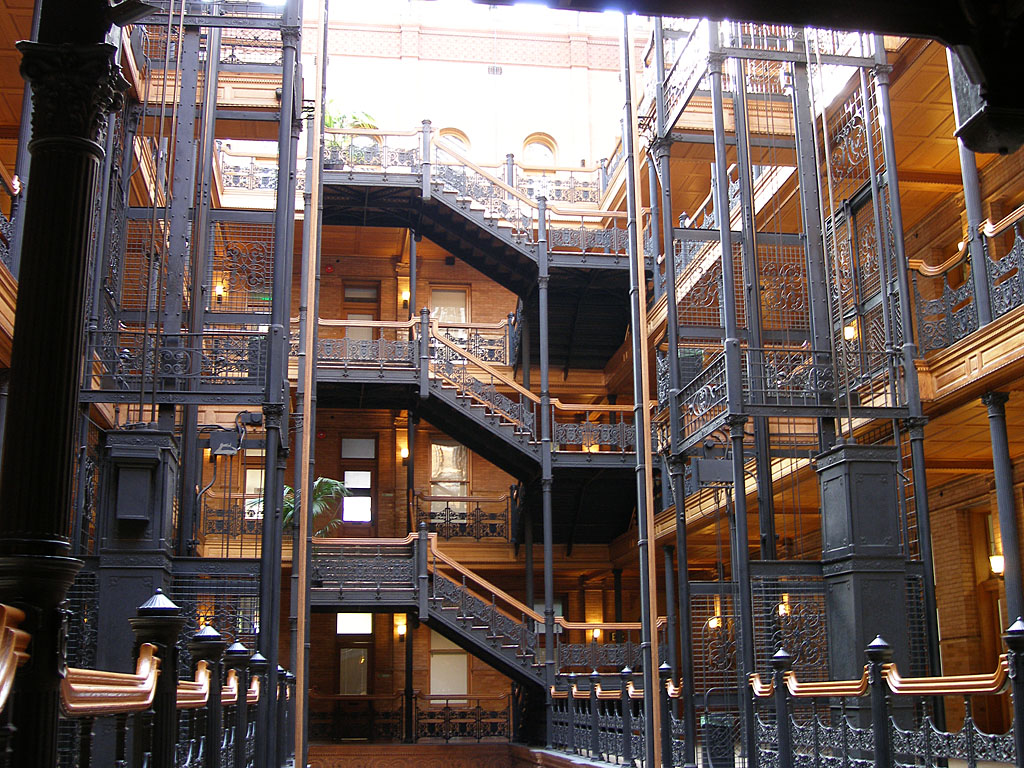
Just to look at it, though, you can understand why the Bradbury Building didn't attract a lot of attention. It doesn't appear to be anything special at all from the outside. It's the interior design of the place that sets it apart from all others of its time, and still makes it a standout to this day...

Introducing the world's first modern open atrium office building.


Photo by J Scott Shannon.


Photo by J Scott Shannon.


Heh. Are you thinking maybe you've seen this interior space before? Well, you probably have! (It was J.F. Sebastian's apartment building in Blade Runner.) :-)

I remember the day so well – I'd dragged my friend Gary along for the ride, and it being a Saturday, we had the whole building essentially to ourselves. It was great! We went up and down one of the ancient elevators at least twice. (It was surprisingly quiet, as I recall.)

*sighs* I always wanted to be an architect when I was growing up, but my teachers and counselors finally convinced me that I didn't have the math or art skills to be good at it. (Thanks a bunch, folks.) I should have just gone ahead and done it anyway. I know now I could have been great. I've always had an eye for beauty in buildings. By and large, I'm very disappointed with the quality of the architecture my generation has produced. I know I'd've done a lot better if I'd had the chance...


Thursday, February 9, 2006

Mystery postcard

This is a "Real Photo" postcard of my mother snapped by a street photographer somewhere in downtown Los Angeles in October, 1936. Mom would have been 19 years old then; a secretary at the Huntington Land Company.


I've wondered about this picture for years. Where exactly was it taken, and what's that almost Stalin-esque building in the background? Adding to the mystery is: I remember this place. My mom used to take me on shopping trips there when I was around 5 years old, which means this place-in-time still existed at least until the late-'50s. Can anybody tell me where in town this is/was, and perhaps help me to finally put this ghost memory to rest?

I'm always struck by Mother's appearance here. She's so young, so self-assured, and so fashionable. Even at that young age, the personal poise she was known for all her life was already in full flower.

And I wouldn't be born for another 18 years...


EDIT, May 17, 2008: Mystery solved! I actually figured out the location a while back, but now I can show you proof positive, thanks to this recent postcard acquisition...

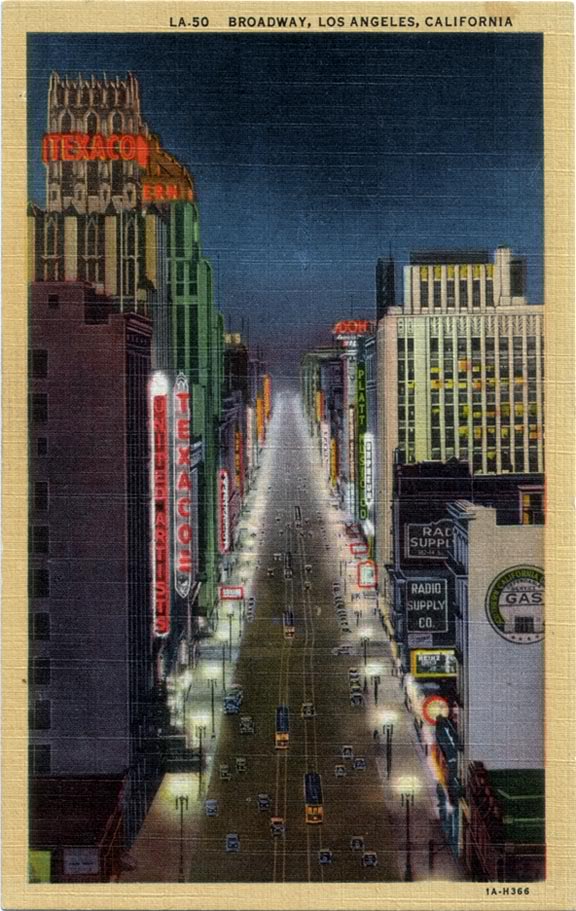
Mother was walking south on the west sidewalk of the 900 block of South Broadway in Los Angeles. Here's a contemporaneous postcard view of this stretch of Broadway at night:


On the right, there's the Radio Supply Co. with the "Stalin-esque" building behind it. That edifice turns out to be the actually rather beautiful Ninth and Broadway Building, built in 1929.

So, hurrah! I've also now even been able to pinpoint within about 50 feet exactly where Mom was on the sidewalk when the picture was taken. I'll leave that for a later post, though. :)