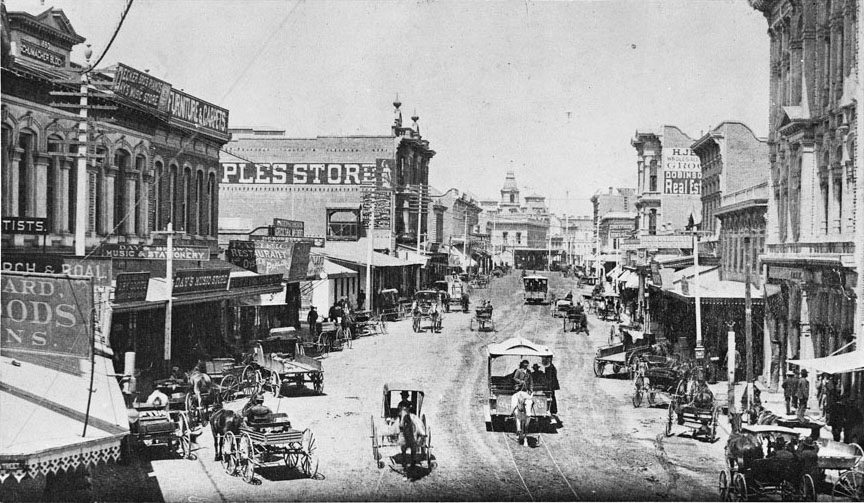
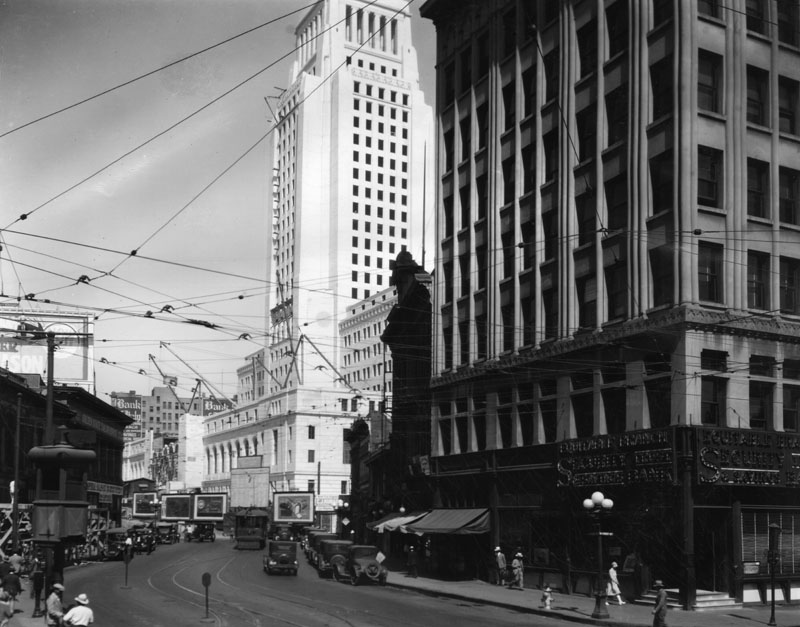
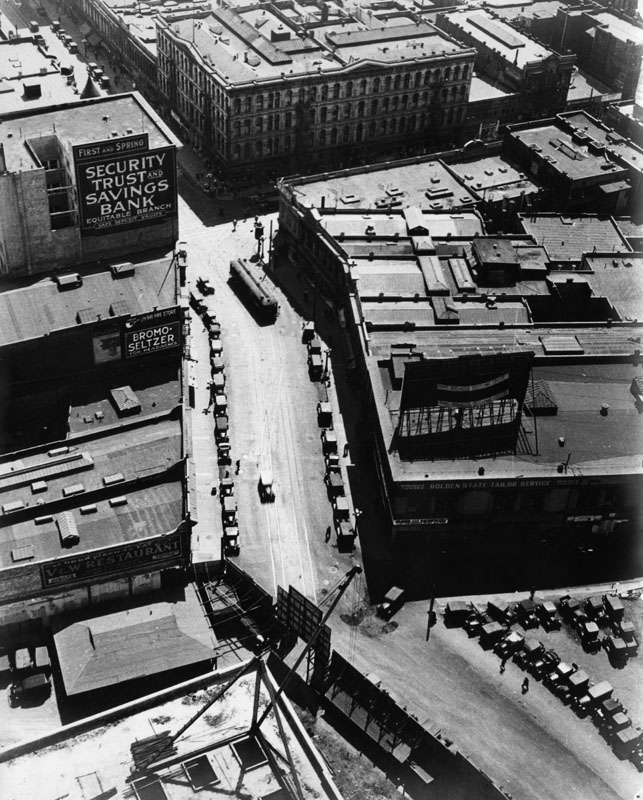
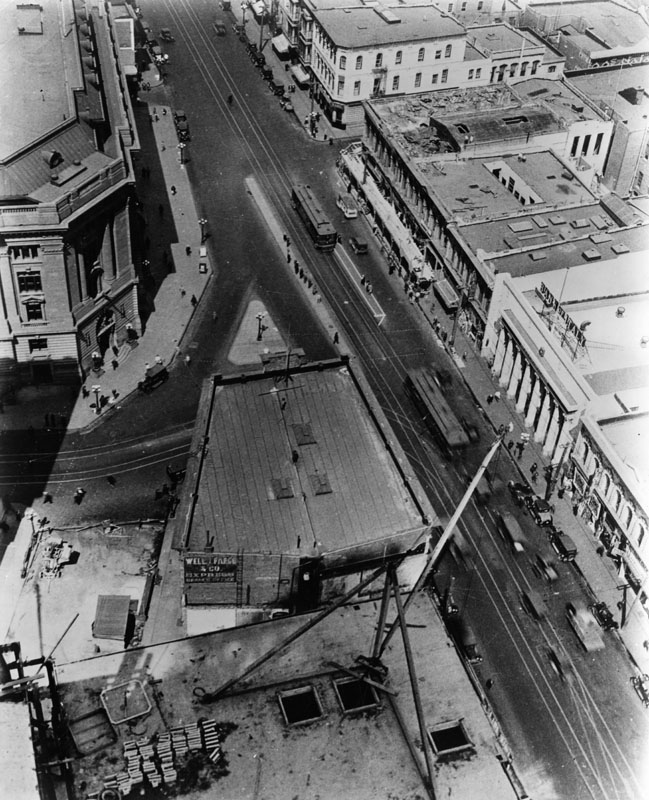
A vanished city lives again...

Showing posts with label civic center. Show all posts

Friday, May 16, 2014

Last Vestiges of Temple Square

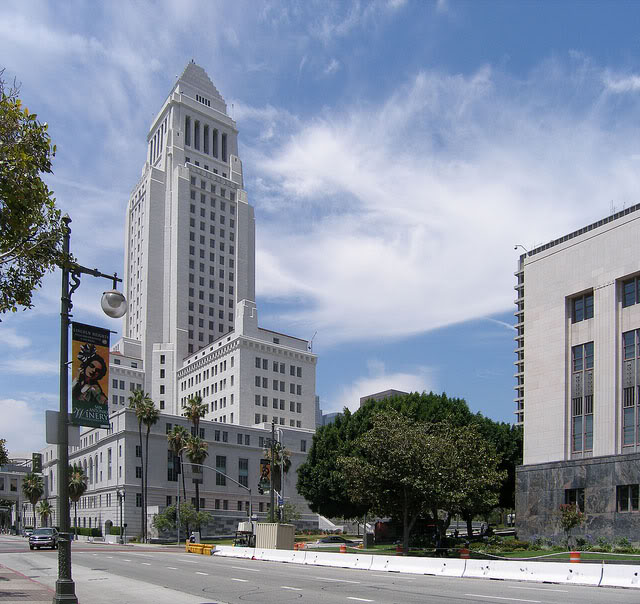
City Hall is perhaps Los Angeles's most iconic and widely recognized landmark. Relatively few are aware, though, that for decades, one of L.A.'s earliest skyscrapers stood directly in the shadow of City Hall at the southeast corner of Spring and Temple Streets.

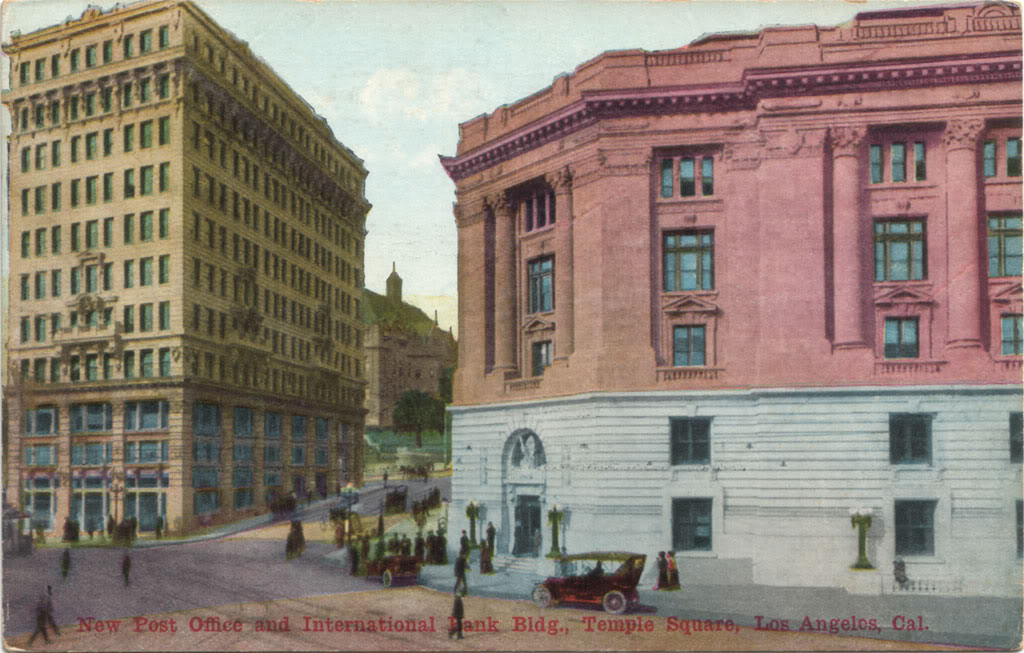
The International Savings & Exchange Bank Building was erected in 1907. When new, it towered over Temple Square and was among the most prestigious business addresses in the city.


"International Bank Building," Palmer Connor, photographer. From the Palmer Connor Collection of Color Slides of Los Angeles. Courtesy of The Huntington Library, San Marino, CA. Link to full-size image.


When construction of the present City Hall began in 1927, almost every structure on the site from Temple Street south to First Street was razed. For reasons that I've never been able to ascertain, however, the Bank of Italy Building, as it was then known, was spared demolition. This aerial view shows the Civic Center circa 1937. The now very much out-of-place bank building can be seen just to the right of City Hall, across Temple Street from the vacant lot where the old Post Office and Federal Building once stood.


Courtesy Los Angeles Public Library.


In contrast to the magnificent and monumental new City Hall, the dingy, aging Bank of Italy building became increasingly regarded as an eyesore. For years, it housed the city's Department of Public Health, but finally, in late 1954, the last remaining structure which stood along the old diagonal alignment of Spring Street was ordered taken down.

Here, looking far older than its actual years, the once-proud grand lady of Temple Square is succumbing to wreckers in January, 1955. The vantage point is the former site of the old 1888 Court House, at that time occupied by a cluster of wartime-era wood frame office structures.


"International Bank Building being demolished," Palmer Connor, photographer. From the Palmer Connor Collection of Color Slides of Los Angeles. Courtesy of The Huntington Library, San Marino, CA. Link to full-size image.

Going, going...
Tuesday, March 5, 2013

Courthouse Time Capsules

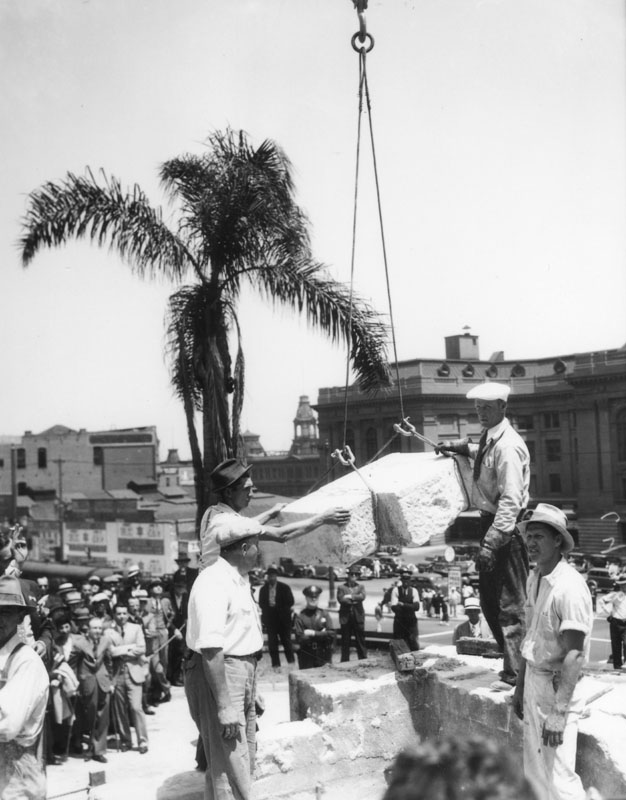
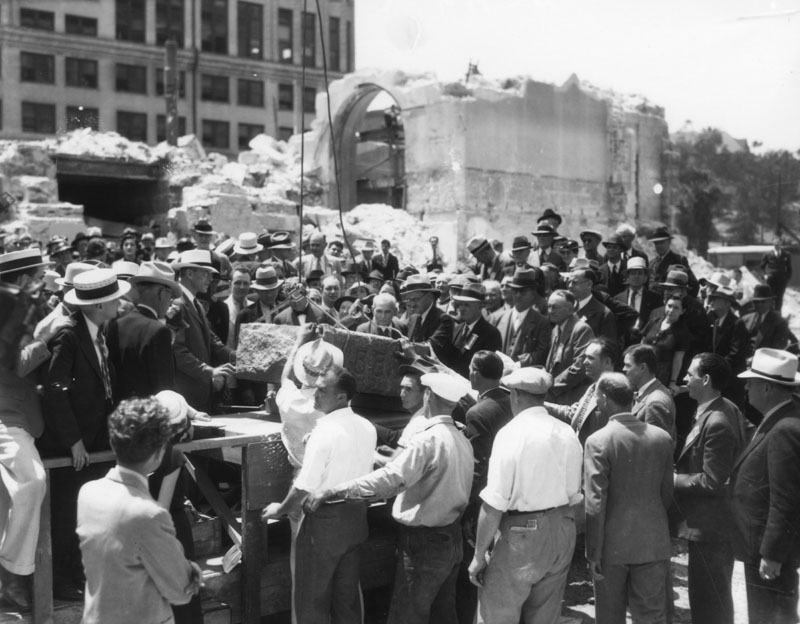
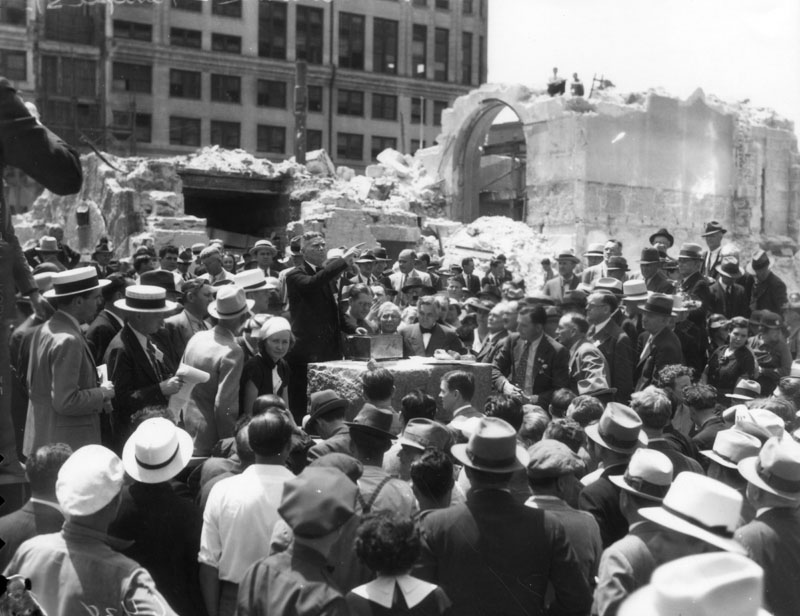
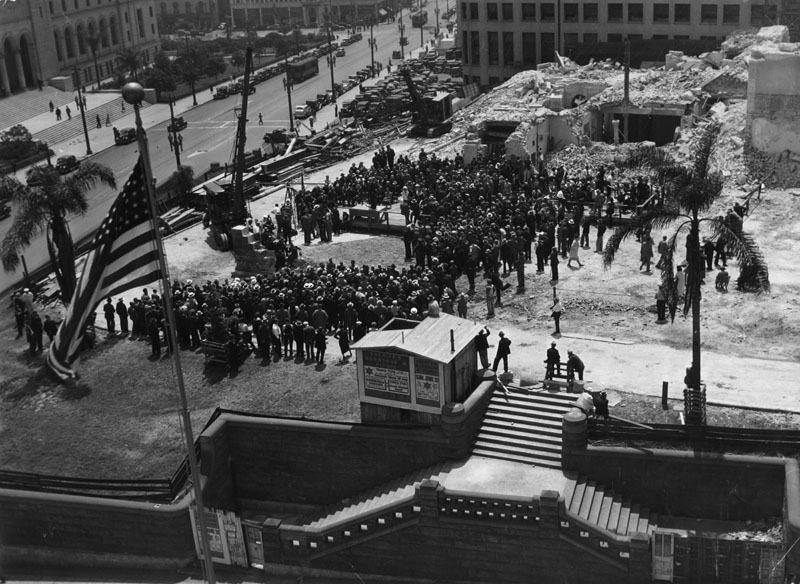
A set of photos of the removal of the cornerstone of the old Los Angeles County Court House, May 12, 1936.

The cornerstone ceremony as viewed from atop the Hall of Justice, across Temple Street. At this point, the cornerstone is still in situ in the small remaining section of wall standing by the crane at left of center.


Courtesy Los Angeles Public Library.

The cornerstone is hoisted free. In the background, at right, across Spring Street, can be seen the rear of the 1909 Federal Building, and to its immediate left, up Main Street, the Baker Block.


Courtesy Los Angeles Public Library.

Here, the granite block is being lowered onto a makeshift platform as the assembled crowd looks on.


Courtesy Los Angeles Public Library.

The time capsule – a small box which appears to be made from tin – is about to be opened by Marshall Stimson, president of the Historical Society of Southern California. Inside were various mementos, newspapers, cards and event programs from the Los Angeles of 1888. (Ref: Courthouses of California: an illustrated history, by Ray McDevitt, California Historical Society.)


Courtesy Los Angeles Public Library.

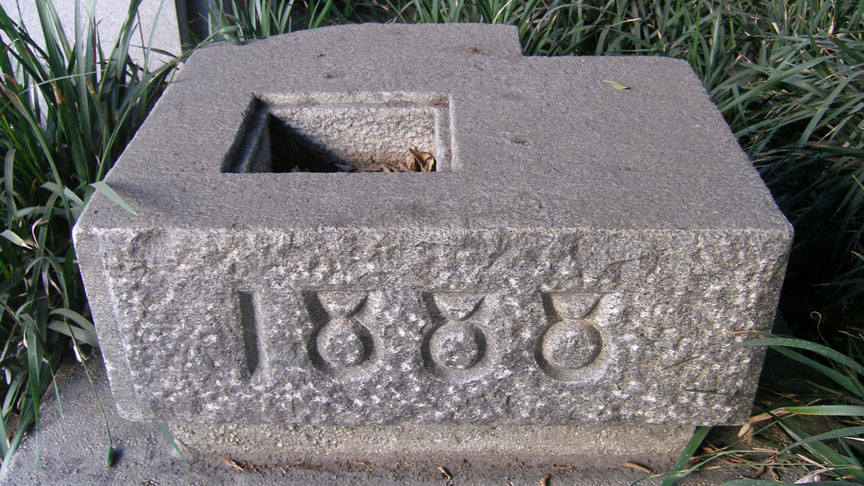
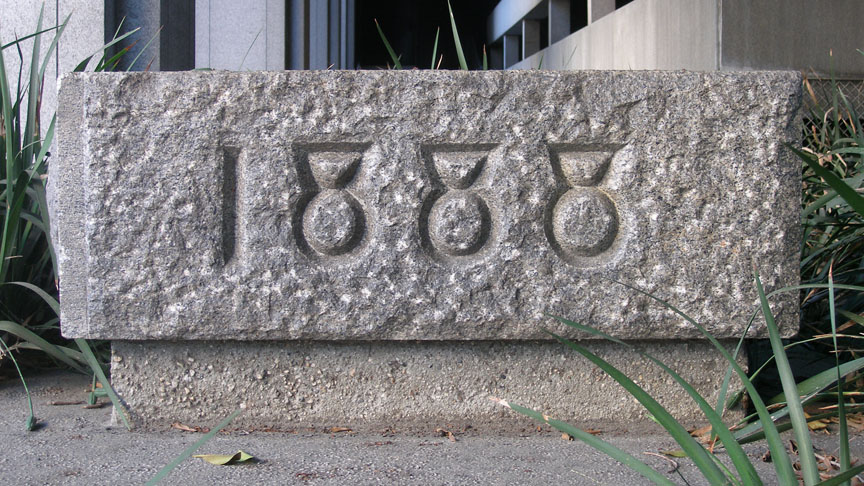
The cornerstone today, on display at the southwest corner of Spring and Temple Streets. It sits in the shadow of the Clara Shortridge Foltz Criminal Justice Center, which has occupied the site of the old Court House since 1972.


Photo by J Scott Shannon.

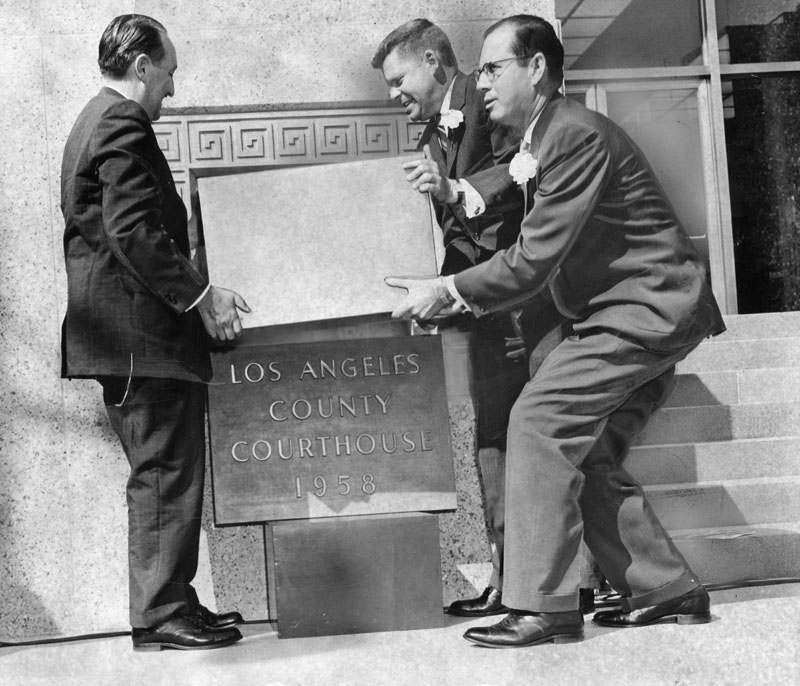
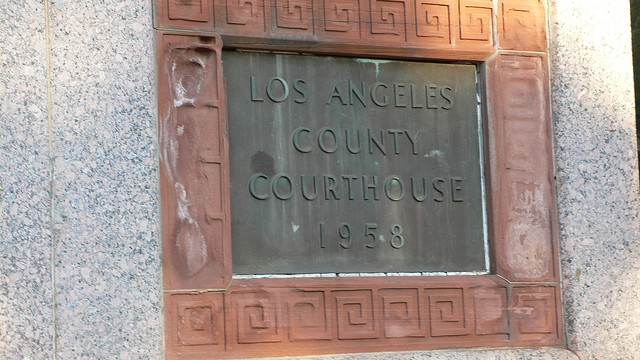
Here, Supervisors Frank Bonelli, Warren Dorn and Kenneth Hahn prepare to place a new time capsule into the cornerstone of the 1958 Los Angeles County Courthouse on October 31, 1958. Now to find out what is in this time capsule!


Courtesy Los Angeles Public Library.


Sunday, July 15, 2012

Court House cornerstone

I'm in Los Angeles on my annual visit right now, and just a few hours ago, I made an astonishing historical discovery. Entirely by happenstance, I found the cornerstone of the old Los Angeles County Court House!


Photo by J Scott Shannon.

During my 2010 trip, I had noticed that the granite blocks that ring the Criminal Justice Center bore an intriguing resemblance to those that were used in the wall around the old Court House, which previously stood at that location. I didn't get a chance to investigate this further at the time, though, but I resolved to check on it on a future visit. (I couldn't do it last year because Michael Jackson's physician's trial was taking place there then.)

Well, today was the day, and while driving east on Temple past the front of the Justice Center, I was giving the granite wall a looksee, when my eye spied a chunk of carved granite behind the wall that had "1888" inscribed on it. Knowing the old Court House had been erected in 1888, I knew at once what that had to be: the long-gone building's original cornerstone!

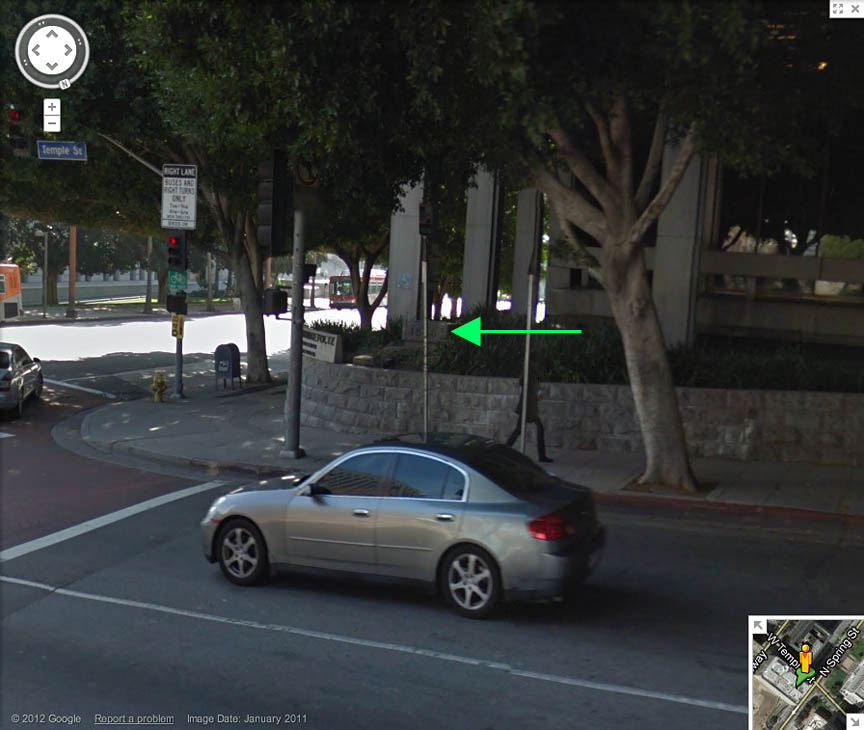
The green arrow shows its location on Google Street View.


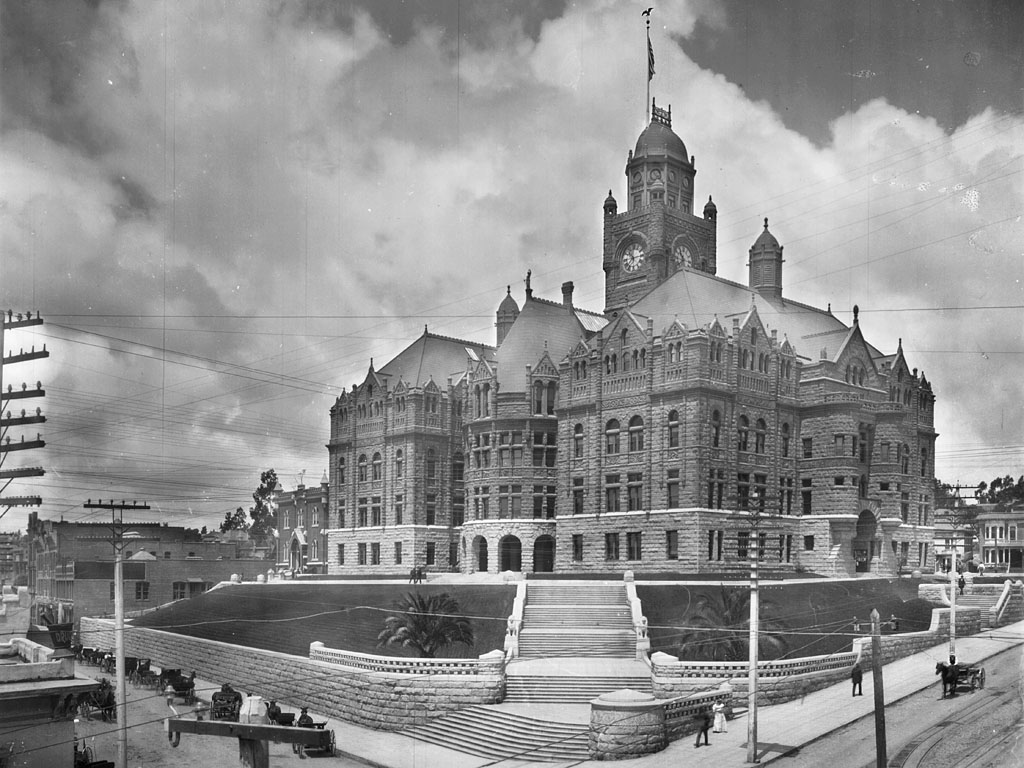
Here's the old Court House, viewed from basically the same street corner before the turn of the last century.


Courtesy U.S.C. Digital Library.

And check it out – obviously there was a time capsule inside!


Photo by J Scott Shannon.

I wonder what it contained. I'm also curious to know where this cornerstone was for the 36 years between the demolition of the old Court House and the construction of the newer building in 1972*.

I'm still not sure if the wall stones are the same ones that used to be in the Court House retaining wall, though. I may never know. But I do know that, almost certainly, the 1888 cornerstone on display at the SW corner of Temple and Spring is the oldest remaining fragment of Los Angeles's Civic Center.

ADDENDA: Since this writing, I've learned that one of the clock faces from the Court House tower has been preserved. Hurrah! Additionally, although I have not yet been able to confirm this, it may be that some decorative pieces of red sandstone from the old Court House were used in the cornerstone of the Stanley Mosk Courthouse at First and Hill Streets.

*Here is the whole story of the Court House cornerstone, courtesy of ProphetM on the Skyscraperpage.com noirish Los Angeles thread.


Photo by formwerks on Flickr.


Friday, August 12, 2011

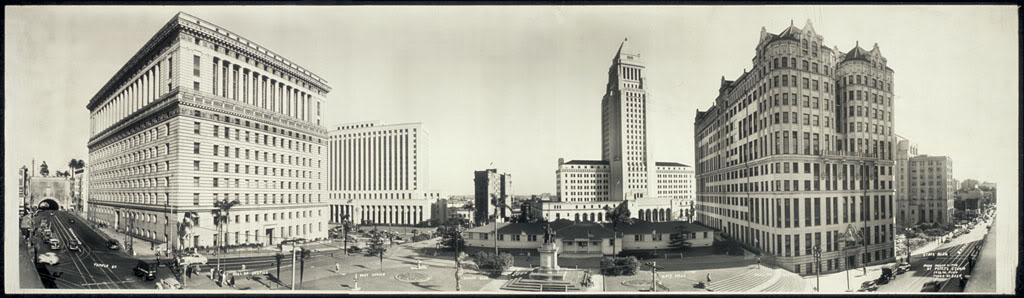
Civic Center panorama, 1946

The Los Angeles Civic Center, viewed from Broadway, March 11, 1946.


Source: Library of Congress.


Link to full-resolution TIFF file at loc.gov (4.6 MB).


Tuesday, June 7, 2011

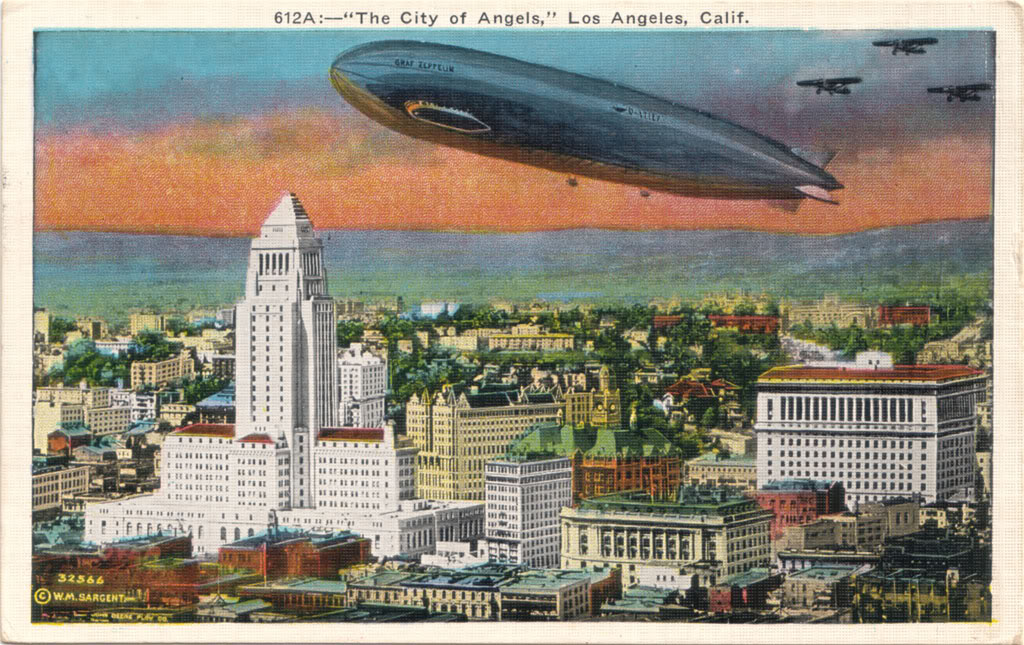
1929 Postcard


I've wanted this particular postcard for a long time, and now I finally have one of my own. The coloring is way off, but the aerial perspective of the Civic Center in 1929 is great. What's most striking to me isn't the Graf Zeppelin; it's that City Hall (left) and the Hall of Justice (far right) are the ONLY two buildings in this entire view that are still standing today. Everything else – every structure, tree, even the hill just beyond the Civic Center – is gone off the face of the earth. And this is Progress!


Wednesday, March 16, 2011

Temple Square: Then, Then, Then & Now

Temple Square – the former junction of Main, Temple and Spring Streets – photographed from the roof of the Bella Union Hotel.

c.1870:


Los Angeles Public Library Photo Collection.


1876:


Los Angeles Public Library Photo Collection.


1888:


Link to image on Flickr.


And here is the view from the former site of the Bella Union in the present day...


Photo by J Scott Shannon.


Sunday, November 22, 2009

Old Civic Center – south to City Hall

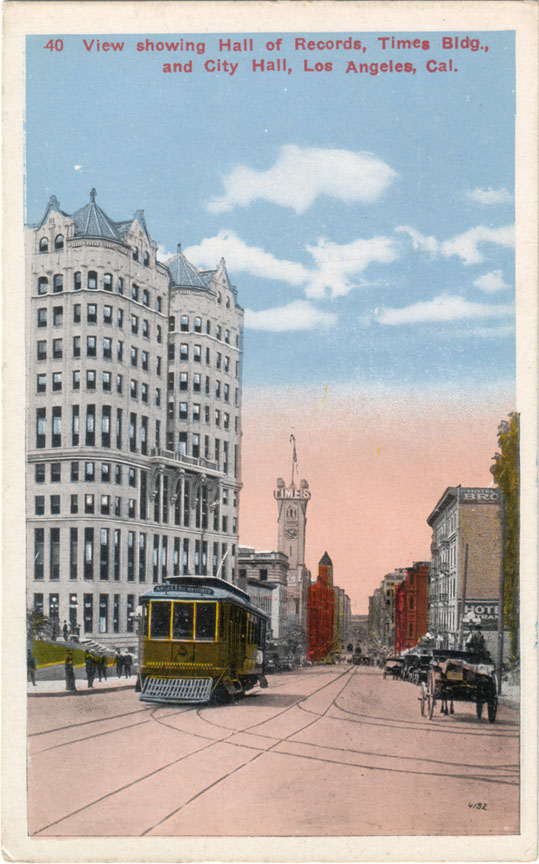
Broadway was the center of civil and commercial life in old Los Angeles. This was the view looking south on Broadway from the Hall Of Records in approximately 1915.


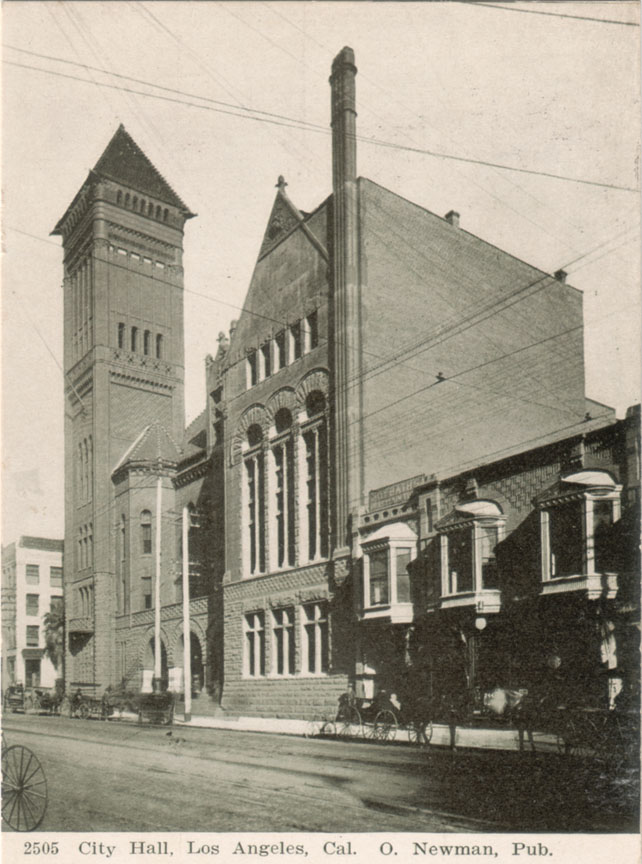
One block down, at the NE corner of Broadway and First, was the L.A. Times building, re-built after the 1910 labor bombing. In the distance, the structure with the pyramid-topped tower was the Los Angeles City Hall, erected in 1888 at 226-238 South Broadway. The postcard view below is from around the turn of the last century.


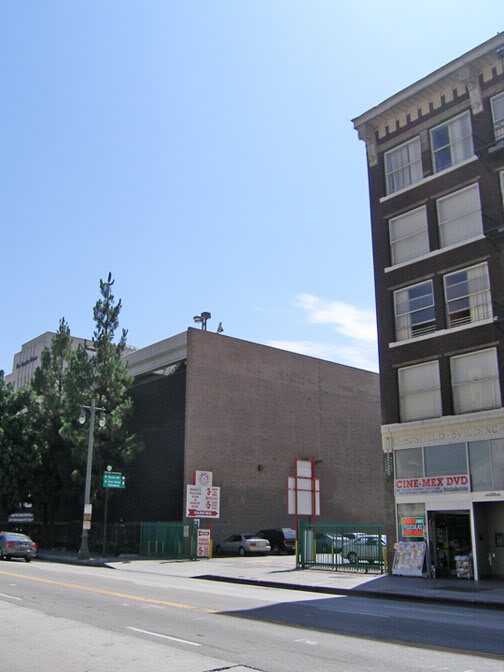
This grand Romanesque edifice of marble and red sandstone stood for only 40 years, however. It was torn down following the completion of the present City Hall in 1928.

Today, there's nothing to show that this was once an important site in Los Angeles history. It's just for parking now.


Photo by J Scott Shannon.


Actually, the old City Hall isn't completely gone. The Hosfield Building at right was built in 1914 as an annex to house city departments. I'd much rather the Hosfield Building was the one razed for parking, though. It really was a crime to demolish that elegant old civic landmark...


Thursday, November 12, 2009

Old Civic Center

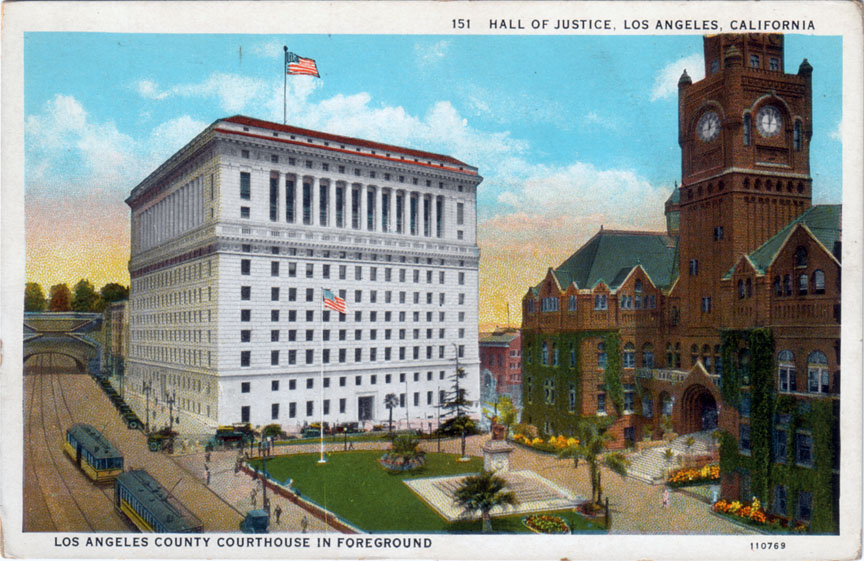
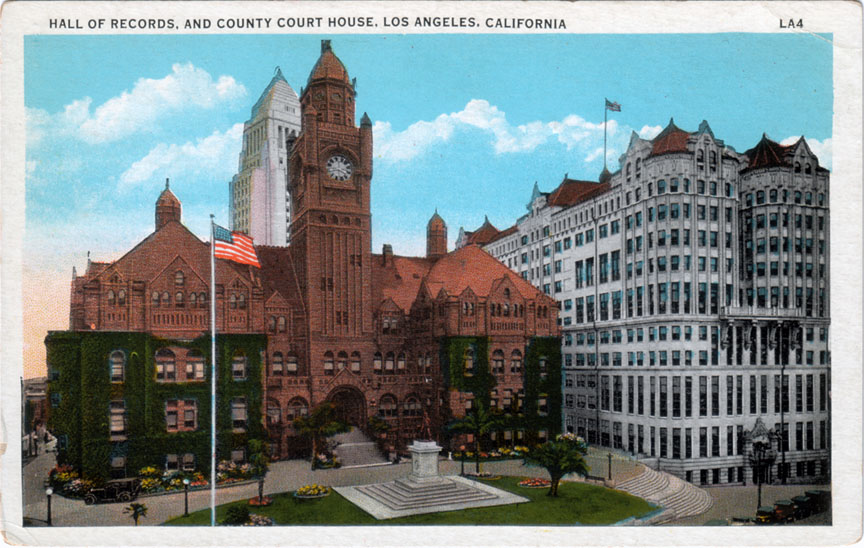
These two postcard views give a really good idea of what the old Los Angeles Civic Center looked like, and where the buildings were in relation to each other.

In the top one, the intersection in the foreground is Broadway and Temple, and we're looking roughly north. At left, where the Broadway Tunnel and those trees are – that's where the 101 freeway "slot" is today. You'll recognize the 1922 Hall of Justice, of course, and the red sandstone building at right is the old Los Angeles County Court House (1888).


Now turn 90 degrees to the right, and see the familiar 1928 City Hall rising behind the Court House, and the Hall Of Records (1910) at right.


Judging by the similarity in the ivy growth on the Court House, I'd say that the two postcard photos were taken within a year or two of each other. The cars in the top one definitely look '20s-ish, and the presence of the new City Hall in the bottom image means it can't be earlier than 1928. So 1928-1930 seems a good guess for when this point in time existed in Los Angeles's past...


Monday, November 9, 2009

The old and the new

Main Street south from Republic Street, 1939:

Today:


Wednesday, November 4, 2009

Temple Square

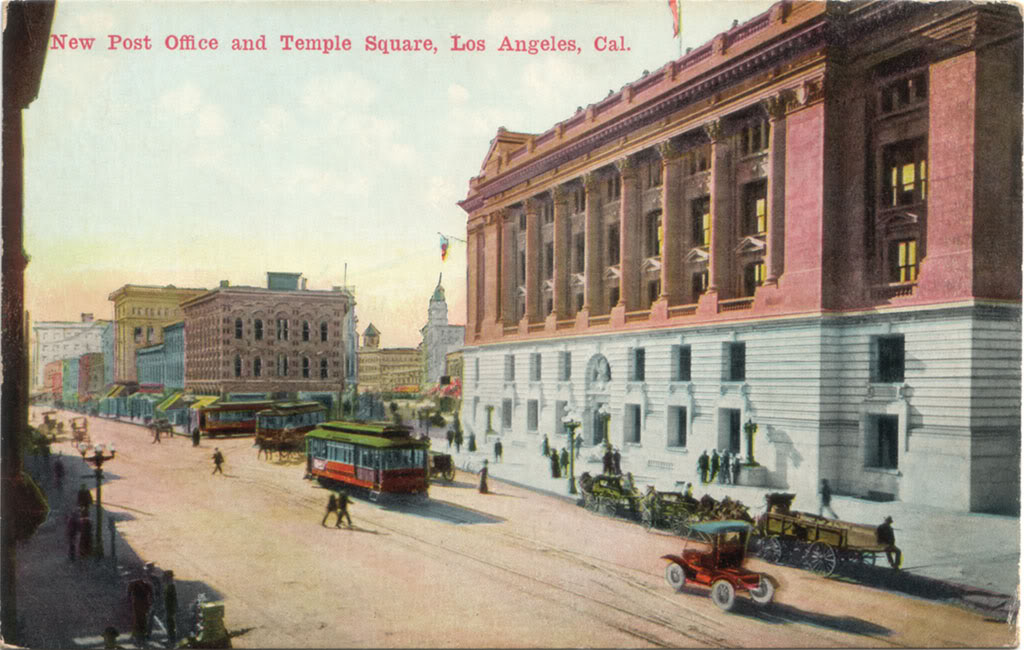
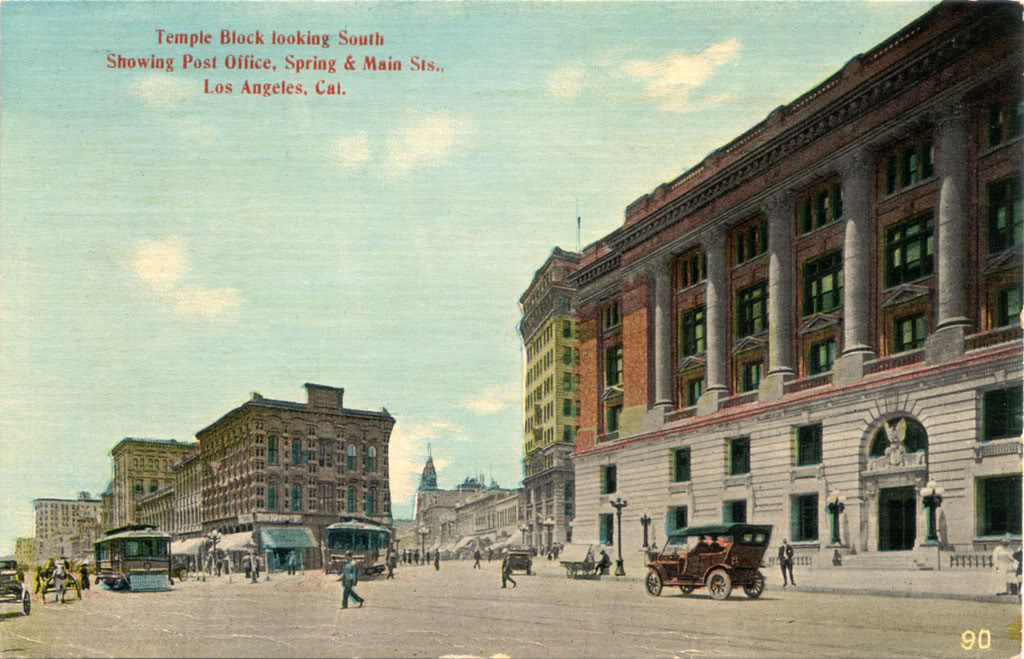
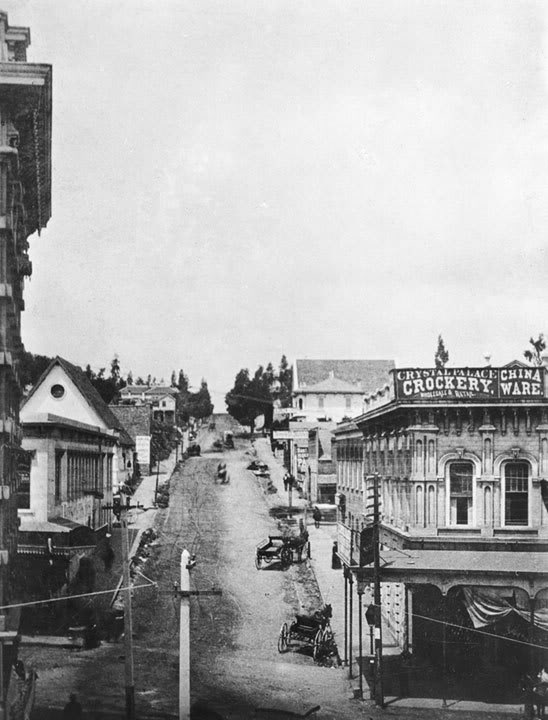
From the 1860s to the 1930s, Temple Square was the original "civic center" of Los Angeles. Formed by the junction of Main, Temple and Spring Streets, it was the nexus of everyday life in the old city. Here are some postcard views of Temple Square from the first and second decades of the 20th century...


Today, no one looking at the intersection of Main and Temple could guess that a grand open public space once existed there. Temple Square has vanished without a trace from the face of the earth...


Friday, September 18, 2009

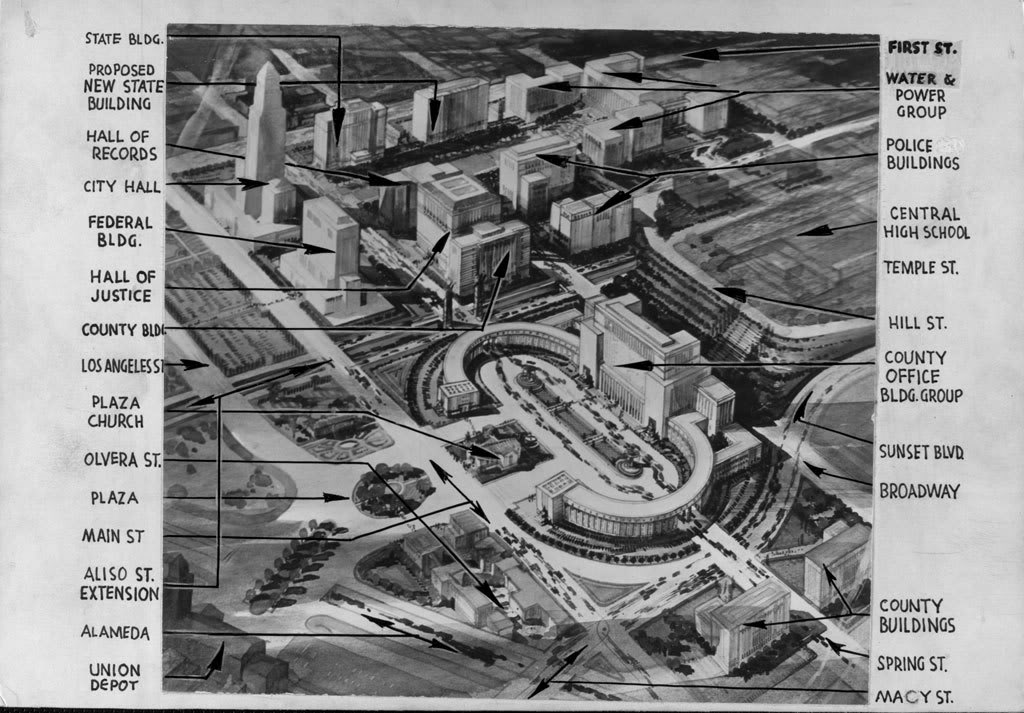
Plan for proposed Los Angeles Civic Center, 1940

At first glance it almost looks like something out of Stalin's USSR, or maybe even the Third Reich. Then parts of it start to look familiar. It's actually the Los Angeles Civic Center – at least someone's idea of what it should look like in the years after 1940.


Courtesy U.S.C. Digital Library.

Look at that completely absurd County government building palace in the foreground. It looks like Las Vegas in downtown L.A.! Thank goodness that monstrosity never got built...

I wish I knew the story behind this proposed but never-implemented plan, but I don't. Given the grandiose nature of that County building, though, it almost had to be the County's idea. ;-)


Saturday, September 5, 2009

The Spring Street diagonal, revisited

In this post from May, I talked about the original diagonal alignment of Spring Street from its intersection with First north to Temple Street. I stated then that the old alignment was done away with when construction began on the new City Hall in 1927. I didn't make that up – I'd read it somewhere else before – but this past week, while looking up reference material on the LAPL website for my last post, I was delighted to discover photographic evidence that at least a portion of the old diagonal still existed until after the new City Hall was completed.

First, here is the Spring Street diagonal looking north from First Street circa 1883:


Photo courtesy U.S.C. Digital Archive.


And here is the same view, only 45 years later:


Photo courtesy Los Angeles Public Library.


See? There's the southern section of the diagonal alignment, still intact, with the completed City Hall in the background!

Then I found this photo of a Spring Street in transition taken around the same time from atop the new City Hall:


Photo courtesy Los Angeles Public Library.


Isn't that neat? I was especially surprised to see that the intersection of Spring and Franklin (foreground) still existed as late as 1928.

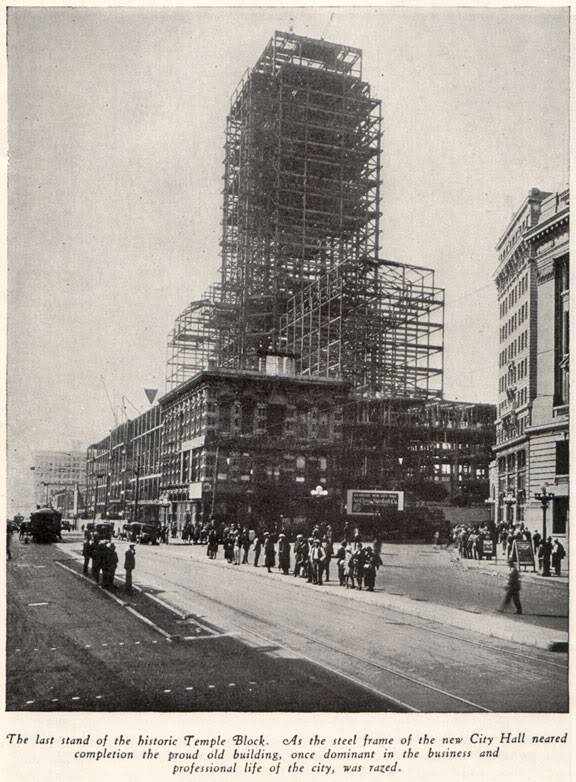
Finally, here's a view from the north side of the new City Hall. That trapezoidal building at center is the ancient Temple Block – once the center of civic life in 19th century Los Angeles – also still standing much later than I imagined.


Photo courtesy Los Angeles Public Library.


And, from this old post, here's the Temple Block and City Hall as viewed from Temple Square:


Photo from La Reina - Los Angeles in Three Centuries, Published by Security Trust & Savings Bank, Los Angeles, 1929.


I love discovering new stuff like this. It really brings the old city alive for me! :-)


Friday, July 10, 2009

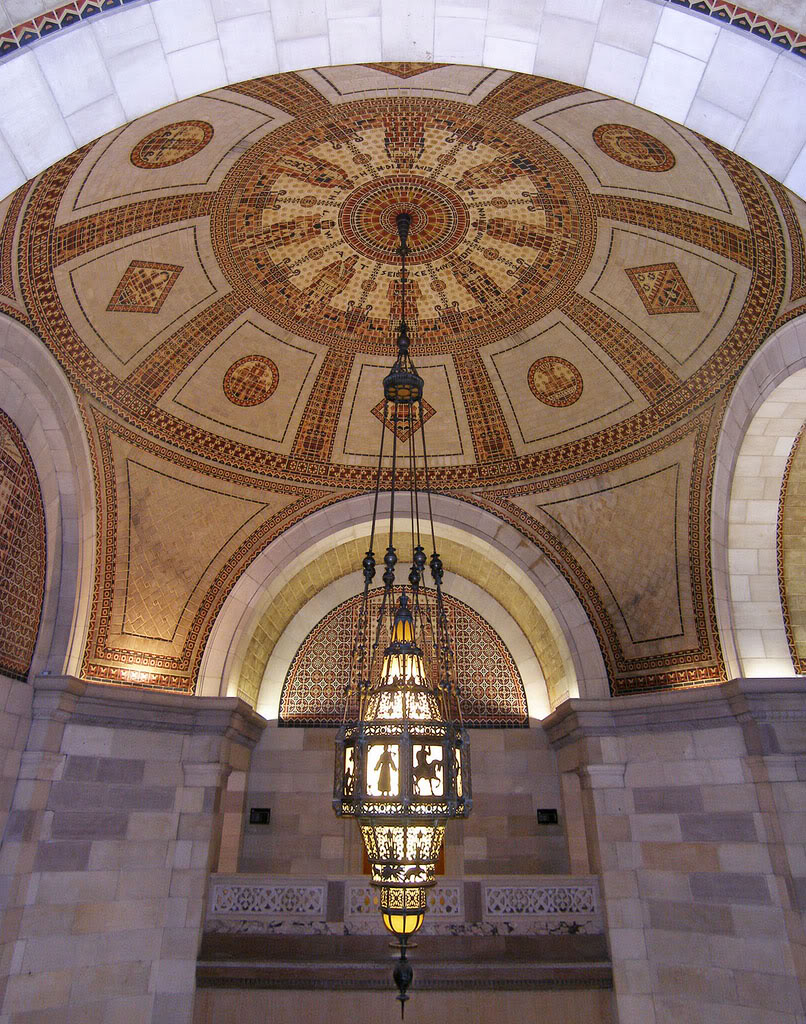
City Hall rotunda

View of the central rotunda from the fourth floor inside Los Angeles City Hall, taken earlier today.


Photo by J Scott Shannon.


Sunday, September 21, 2008

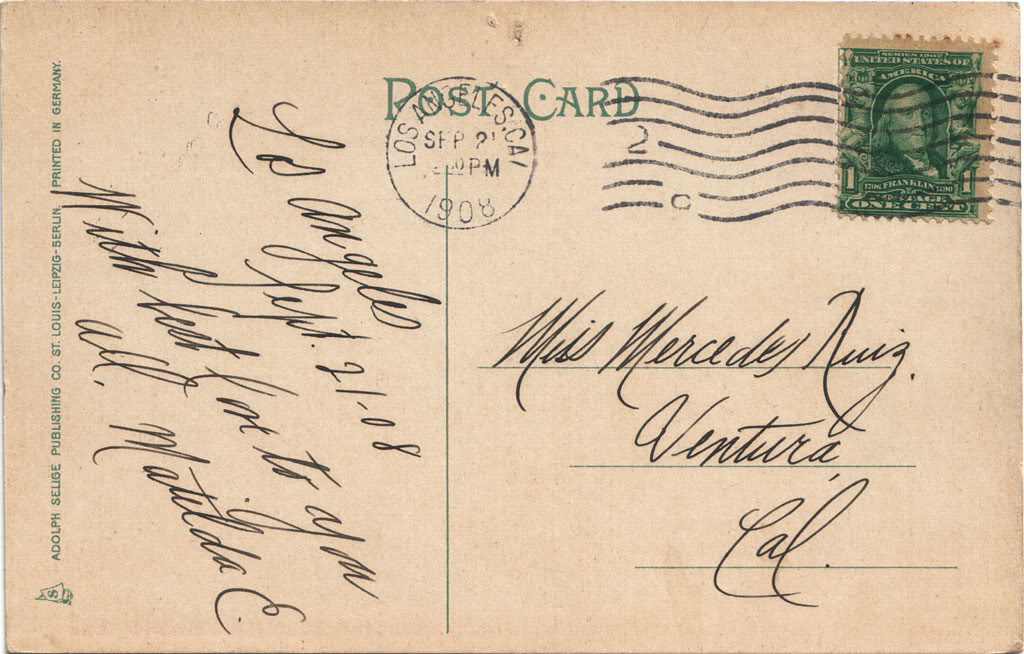
Birthday postcard

Got an unexpected surprise via eBay the other day: an old postcard mailed exactly 100 years ago today, and 46 years before I would be born.

It features a really nice view of the old L.A. County Court House, too; probably the nicest in my postcard collection.


Lovely penmanship...


Thursday, May 15, 2008

Temple and Main Streets, Los Angeles: Then and Now

The civic center of Los Angeles in three centuries...

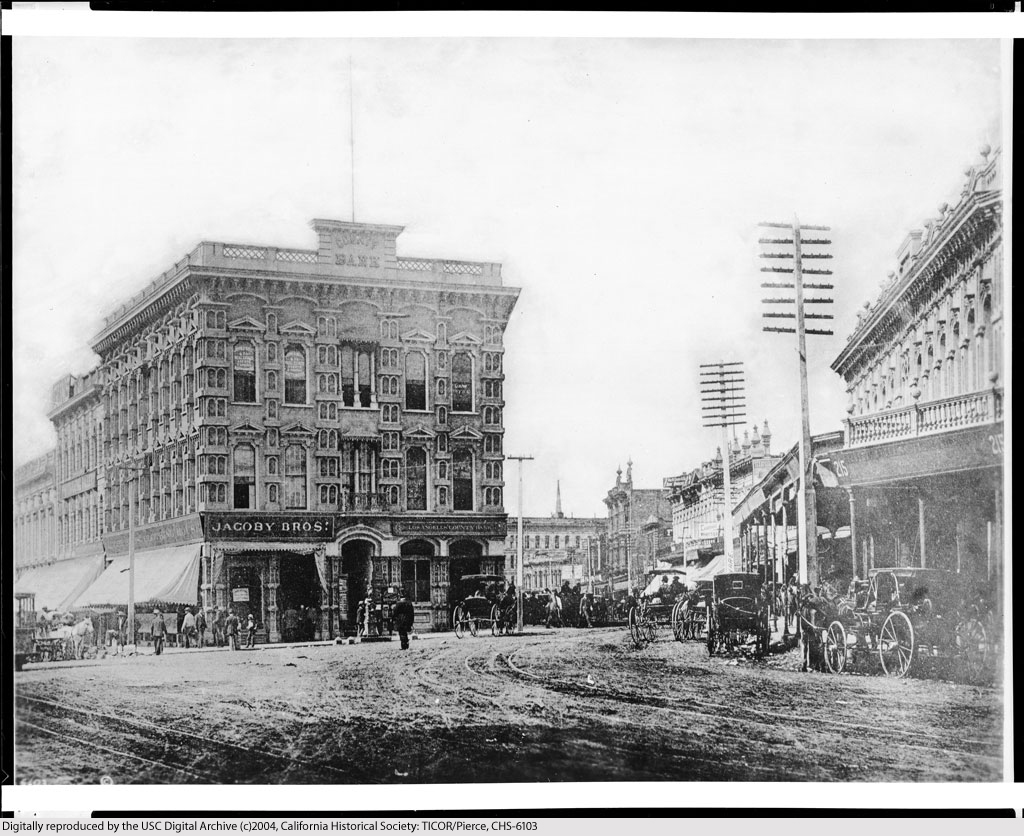
Temple Square – the heart of the city, 1885 – at the intersection of Temple, Main and Spring Streets:


USC Digital Archive.


Temple Square, 1927. The new City Hall looms over the doomed Temple Block:


Photo from La Reina - Los Angeles in Three Centuries, Published by Security Trust & Savings Bank, Los Angeles, 1929.


Temple and Main Streets, today:


Photo by J Scott Shannon.


The Temple Block was the ornate 3-storey brick structure in the older photos. It was the hub of civil life in Los Angeles during the 1870s-1880s. As we face the Temple Block, Main Street runs to the left, and Spring Street emerges at a diagonal angle to the right. Temple Street runs from left to right in the upper photo, but it can't be seen because it's obscured by the Downey Block at far right. (Here is Temple Street heading west from Temple Square.)

Spring Street was realigned when construction of the new City Hall began in early 1927. Spring now runs parallel to Main, and intersects with Temple where the large skyscraper at right is now located.

What strikes me the most when I compare these images is how the city center of old Los Angeles was a vibrant place, alive with people and commerce, while today's sterile Civic Center is almost exclusively a home for government, and where the populace is only a transitory visitor.

It's difficult to imagine this extensive a change taking place within a period of only two normal human lifespans, isn't it? Were a citizen of 19th century Los Angeles to suddenly find themself transported to today's Temple and Main, the place would no doubt be completely alien to them. Like another world entirely...