A vanished city lives again...

Showing posts with label old post office. Show all posts

Friday, May 16, 2014

Last Vestiges of Temple Square

City Hall is perhaps Los Angeles's most iconic and widely recognized landmark. Relatively few are aware, though, that for decades, one of L.A.'s earliest skyscrapers stood directly in the shadow of City Hall at the southeast corner of Spring and Temple Streets.

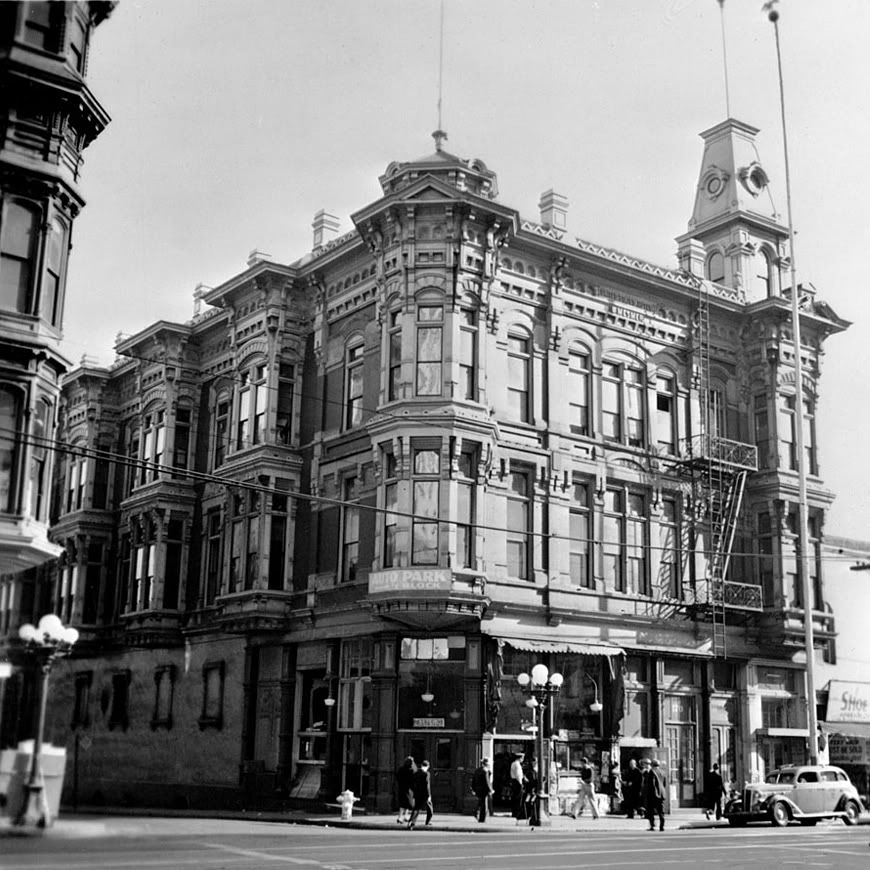
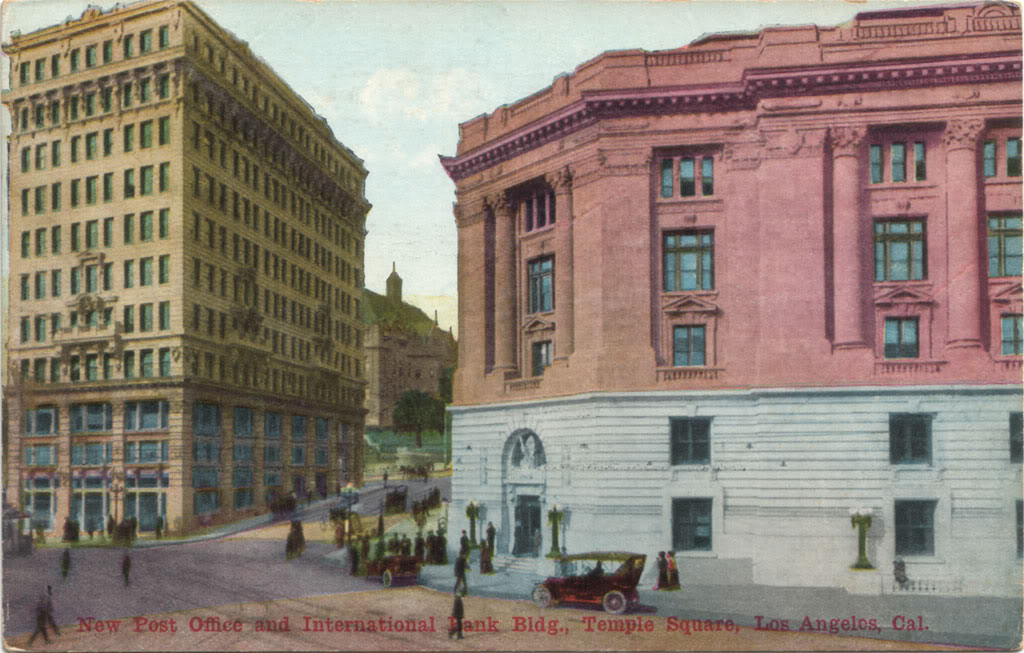
The International Savings & Exchange Bank Building was erected in 1907. When new, it towered over Temple Square and was among the most prestigious business addresses in the city.


"International Bank Building," Palmer Connor, photographer. From the Palmer Connor Collection of Color Slides of Los Angeles. Courtesy of The Huntington Library, San Marino, CA. Link to full-size image.


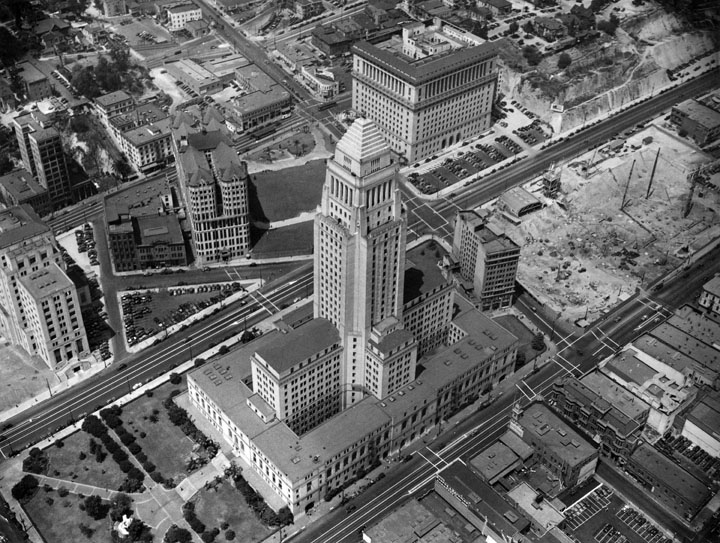
When construction of the present City Hall began in 1927, almost every structure on the site from Temple Street south to First Street was razed. For reasons that I've never been able to ascertain, however, the Bank of Italy Building, as it was then known, was spared demolition. This aerial view shows the Civic Center circa 1937. The now very much out-of-place bank building can be seen just to the right of City Hall, across Temple Street from the vacant lot where the old Post Office and Federal Building once stood.


Courtesy Los Angeles Public Library.


In contrast to the magnificent and monumental new City Hall, the dingy, aging Bank of Italy building became increasingly regarded as an eyesore. For years, it housed the city's Department of Public Health, but finally, in late 1954, the last remaining structure which stood along the old diagonal alignment of Spring Street was ordered taken down.

Here, looking far older than its actual years, the once-proud grand lady of Temple Square is succumbing to wreckers in January, 1955. The vantage point is the former site of the old 1888 Court House, at that time occupied by a cluster of wartime-era wood frame office structures.


"International Bank Building being demolished," Palmer Connor, photographer. From the Palmer Connor Collection of Color Slides of Los Angeles. Courtesy of The Huntington Library, San Marino, CA. Link to full-size image.

Going, going...
Tuesday, March 5, 2013

Courthouse Time Capsules

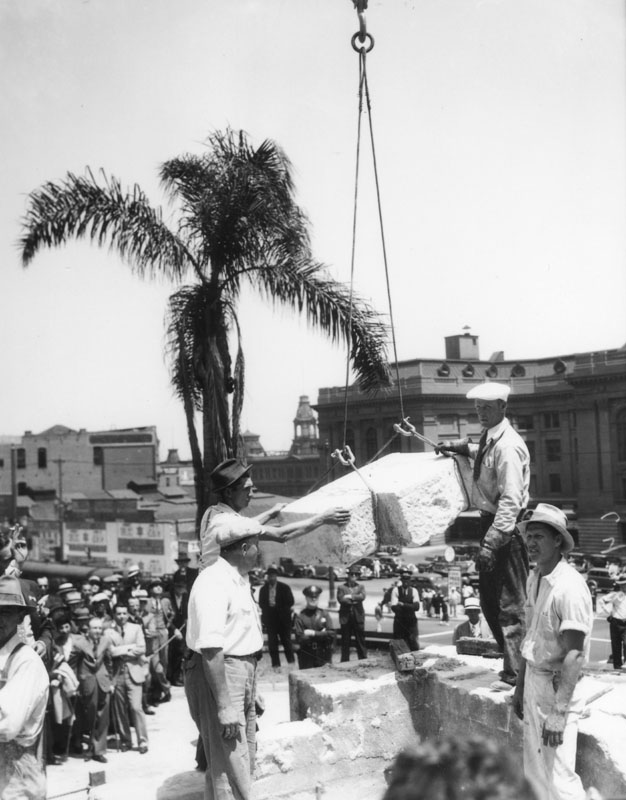
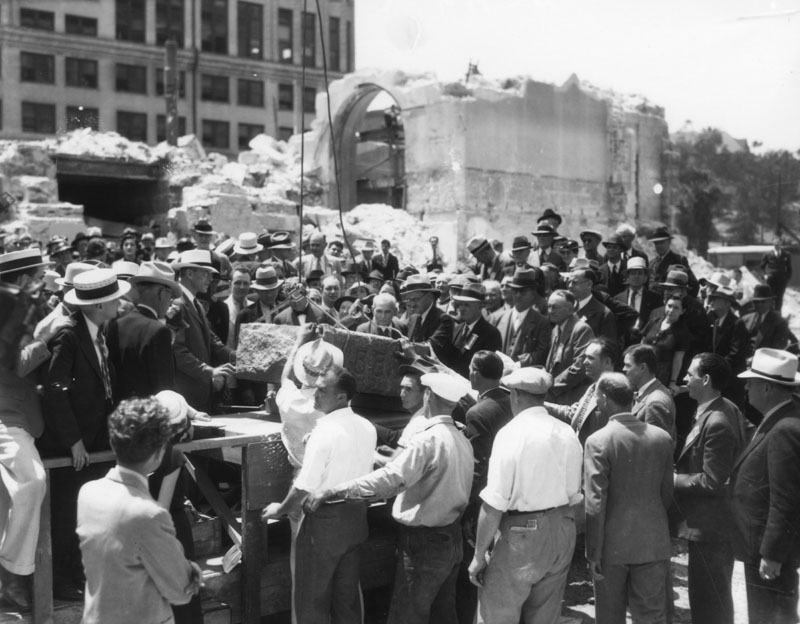
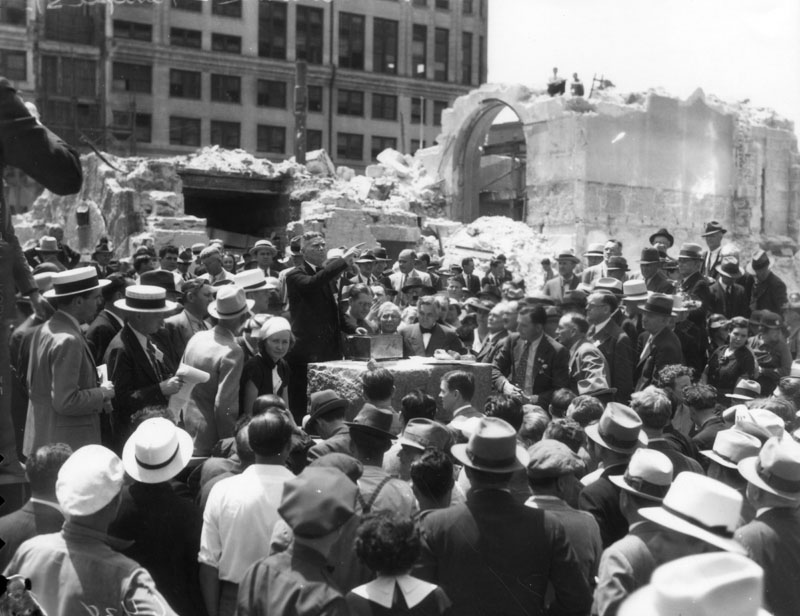
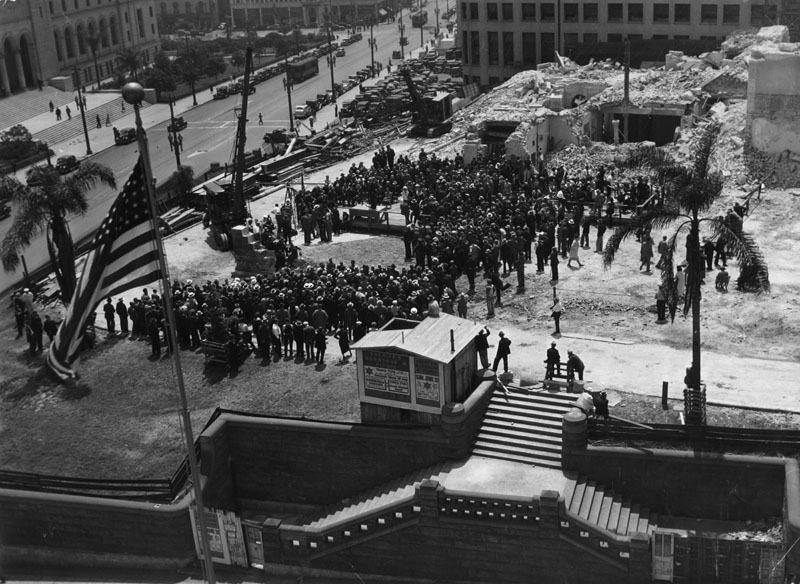
A set of photos of the removal of the cornerstone of the old Los Angeles County Court House, May 12, 1936.

The cornerstone ceremony as viewed from atop the Hall of Justice, across Temple Street. At this point, the cornerstone is still in situ in the small remaining section of wall standing by the crane at left of center.


Courtesy Los Angeles Public Library.

The cornerstone is hoisted free. In the background, at right, across Spring Street, can be seen the rear of the 1909 Federal Building, and to its immediate left, up Main Street, the Baker Block.


Courtesy Los Angeles Public Library.

Here, the granite block is being lowered onto a makeshift platform as the assembled crowd looks on.


Courtesy Los Angeles Public Library.

The time capsule – a small box which appears to be made from tin – is about to be opened by Marshall Stimson, president of the Historical Society of Southern California. Inside were various mementos, newspapers, cards and event programs from the Los Angeles of 1888. (Ref: Courthouses of California: an illustrated history, by Ray McDevitt, California Historical Society.)


Courtesy Los Angeles Public Library.

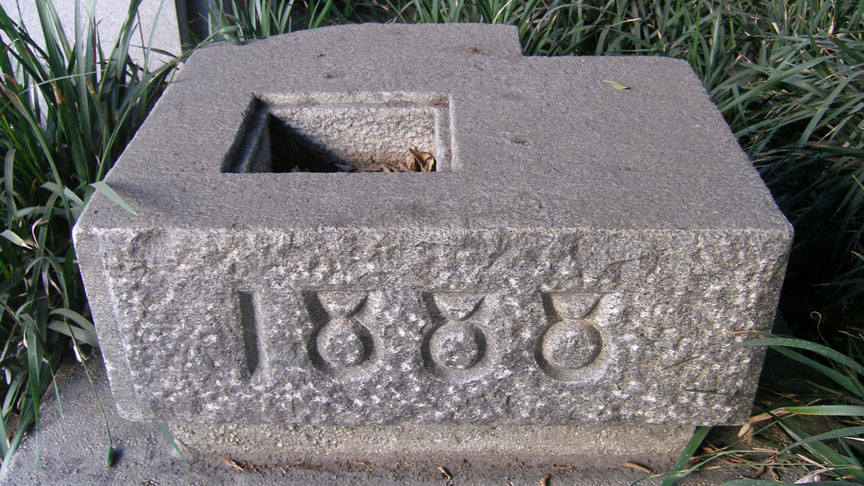
The cornerstone today, on display at the southwest corner of Spring and Temple Streets. It sits in the shadow of the Clara Shortridge Foltz Criminal Justice Center, which has occupied the site of the old Court House since 1972.


Photo by J Scott Shannon.

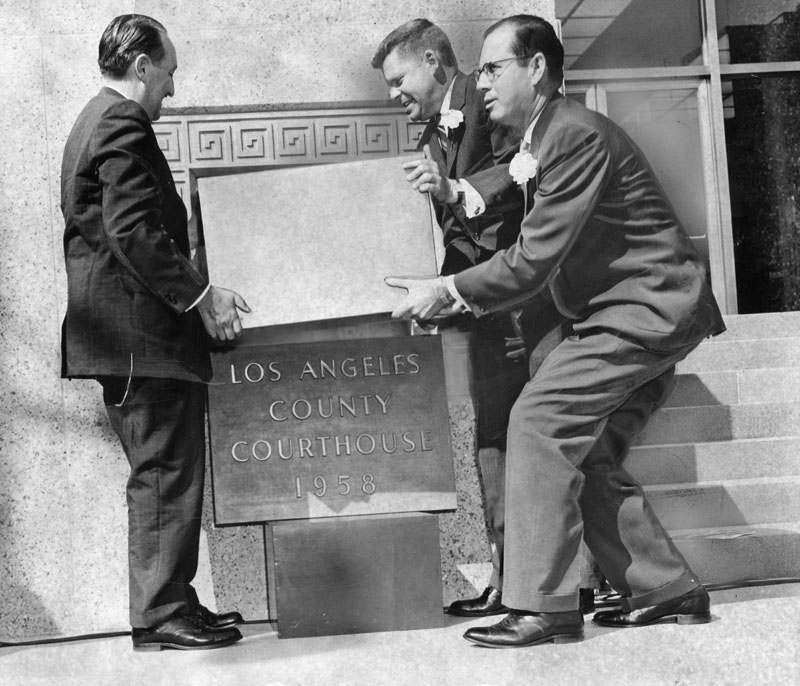
Here, Supervisors Frank Bonelli, Warren Dorn and Kenneth Hahn prepare to place a new time capsule into the cornerstone of the 1958 Los Angeles County Courthouse on October 31, 1958. Now to find out what is in this time capsule!


Courtesy Los Angeles Public Library.


Tuesday, June 7, 2011

1929 Postcard


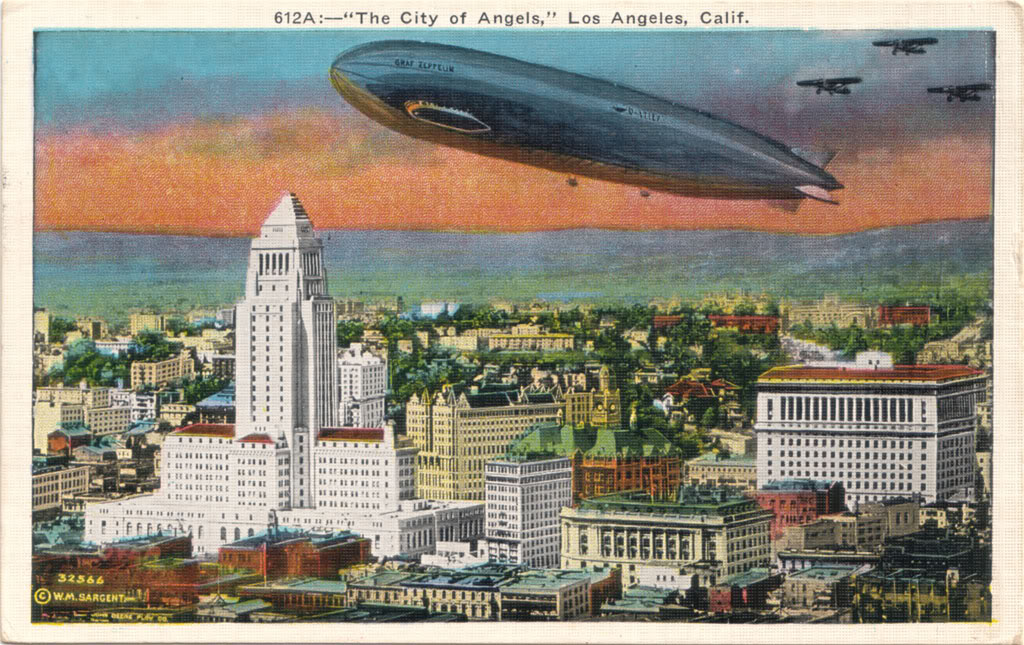
I've wanted this particular postcard for a long time, and now I finally have one of my own. The coloring is way off, but the aerial perspective of the Civic Center in 1929 is great. What's most striking to me isn't the Graf Zeppelin; it's that City Hall (left) and the Hall of Justice (far right) are the ONLY two buildings in this entire view that are still standing today. Everything else – every structure, tree, even the hill just beyond the Civic Center – is gone off the face of the earth. And this is Progress!


Sunday, March 27, 2011

Time-traveling to Old L.A.

Reader and past contributor Nathan Marsak posited a question the other day: what if you had a time machine, and you could pop back to Old L.A. for a weekend. What time in the city's history would you choose?

For me, without a doubt, it would be the weekend of October 14-16, 1910.

Why? Mostly, it would be to attend the Saturday dedication of the brand new 'Million-Dollar' Post Officethe building which first sparked my interest in L.A. history.


U.S.C. Digital Library.


For my accommodations, I'd book the top-floor corner room at the United States Hotel at Main and Market Sts., which would have an absolutely perfect vantage point for viewing the festivities in Temple Square.


U.S.C. Digital Library.


There'd be plenty of other things to see and do while I was there, of course. Assuming I could get my hands on a period camera, I'd take a ton of good pictures of various buildings for posterity, especially the ruins of the L.A. Times Building, which had been terror-bombed only two Saturdays ago.

I would also love to take a 360-degree panorama from the top of the 1888 Court House. (1910 would be the last year you could do that, with the Hall of Records rising immediately south of the Court House at that time.)

I'd also try to get an Edison cylinder recording of the bell chimes of the old Court House (and the 1888 City Hall's bells, if there actually were bells in that tower – does anyone know for sure?).

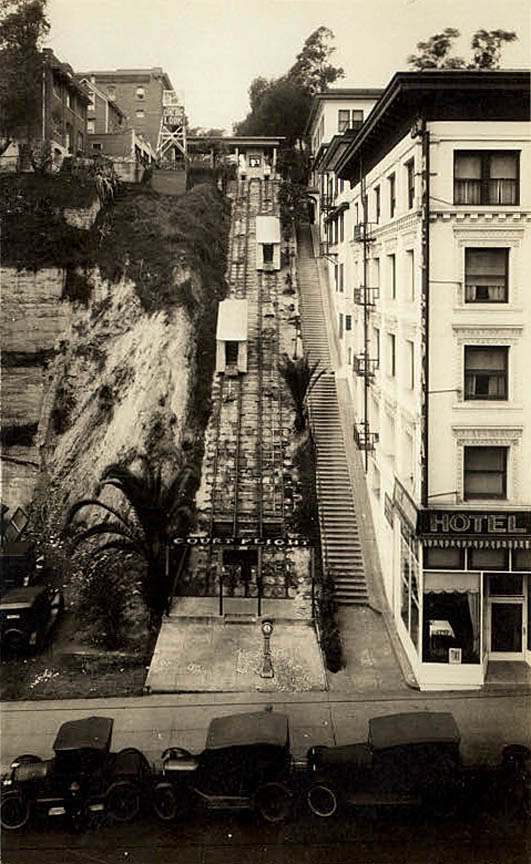
And I'd probably walk the old diagonal alignment of Spring Street about a dozen times. I'd ride Court Flight over and over, too, until they kicked me off of it. (Never mind Angels Flight – been there, done that, 50 years later.) ;)


Court Flight.


Re: dining – I'd probably eat breakfasts at the Hollenbeck Hotel and the Hotel Nadeau, and at least one lunch at the little hole-in-the-wall indicated in this old postcard. It had to be good! Someone actually wrote home about it!


But mostly I'd eat as much "Spanish" food (as Mexican food was called at the time) as I could. I'd be very curious to know what the native cuisine tasted like a hundred years ago!

I'd do a bunch of other things, too, including a mandatory jaunt down to the Longstreet Palms. World-famous at the time, no visit to old L.A. would be complete without seeing them!


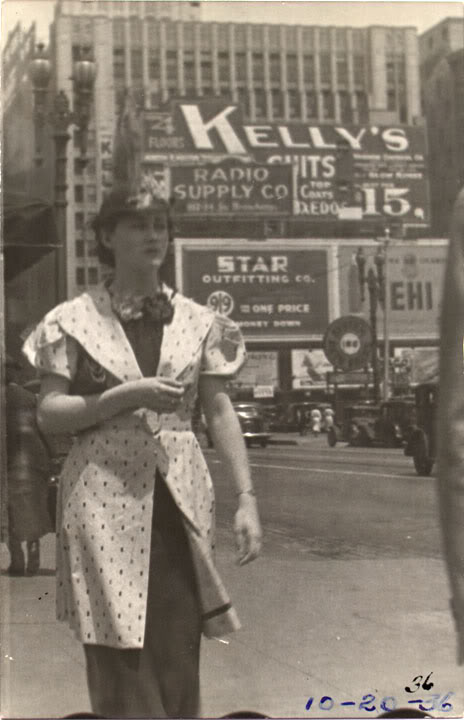
Another time I'd like to travel back to would be October of 1936, so I could see the Los Angeles that my mother knew when she first moved there. Of course, Number One on my list of places to visit then would be the incredible Richfield Building. I'd also take my own set of panoramic photos from atop City Hall, and go to the Paris Inn every night for dinner, too. My kind of place, definitely!

But most of all, I'd make sure to be hanging out at the northwest corner of Olympic and Broadway during lunch hour on Tuesday, October 20th, so I could watch a certain snooty young lady get her picture taken by a street photographer. 8)


Ooooh, now here's a Twilight Zone thought for you – what if Mom's photographer actually turned out to be time-traveler Me?!  D:


Friday, October 15, 2010

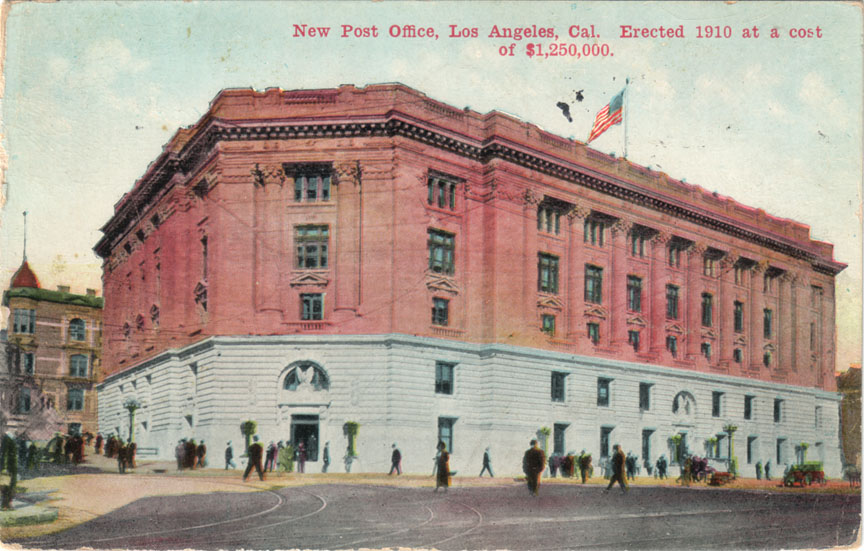
"The Million-Dollar Post Office"


Courtesy USC Digital Library.

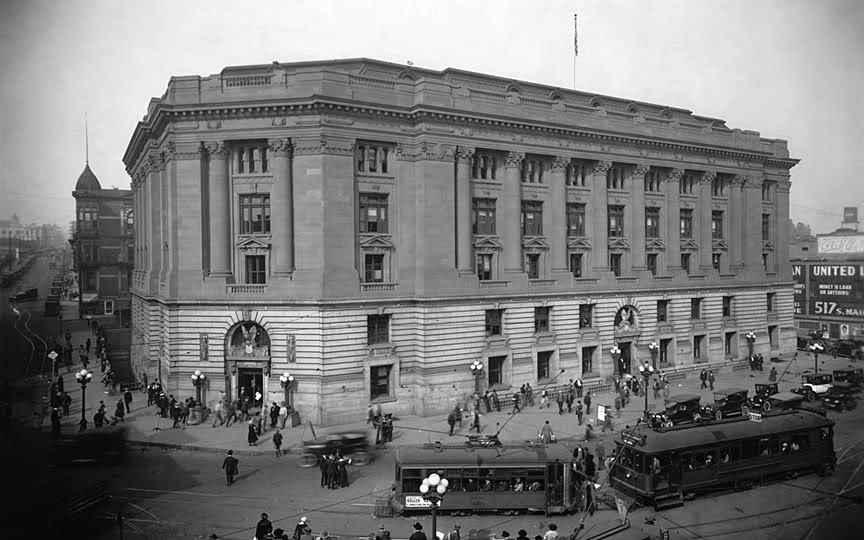
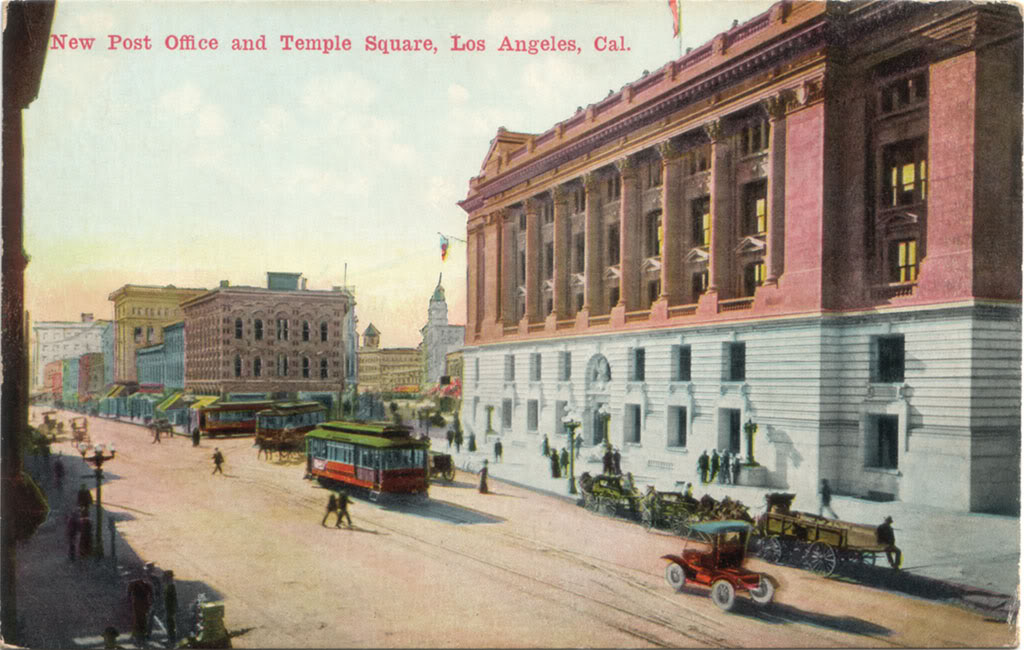
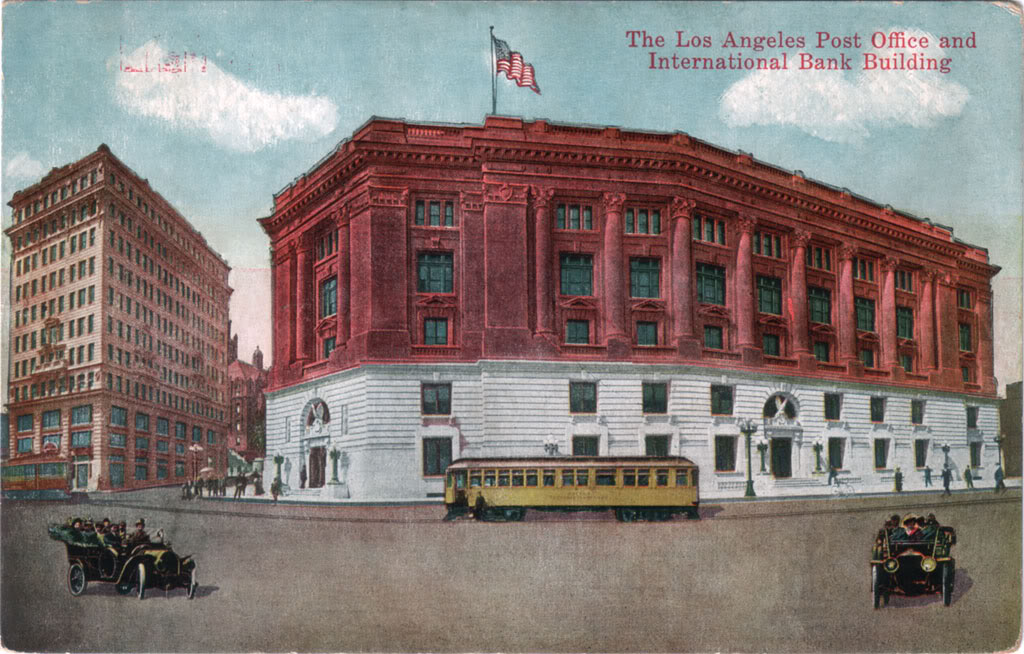
In Los Angeles history, October 1910 is indelibly associated with the unionist terror bombing of the Times Building, but just a fortnight after one major building in the city was destroyed by murderous violence, another important edifice was opened to the public with great jubilation and fanfare, 100 years ago today. It was the brand new Federal Building at Temple Square, colloquially (and somewhat derisively) referred to at the time as "The Million-Dollar Post Office," and it was the pride and joy of the whole city when it was officially dedicated on October 15, 1910.

Sadly, although clearly designed and built to endure for ages, this classic civic building would stand for only 27 years.


Monday, June 7, 2010

100 years ago today

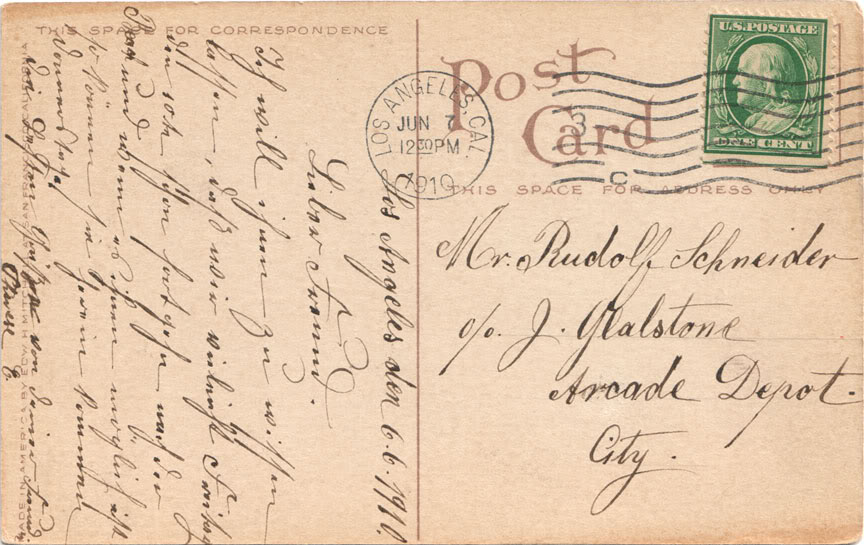
Another Spring Street treasure I acquired recently is this postcard that "Therese E." mailed to a Mr. Rudolf Schneider. It was postmarked exactly 100 years ago today.


The postcard depicts the old diagonal alignment of Spring Street which existed before 1928. There are many variants of this image on postcards from this era, but I've never seen one with this sharpness of detail.


The building at the end of Spring Street with the high arched doorway is Los Angeles's then-new Post Office and Federal Building. At the time the postcard was mailed, the impressive edifice had already been under construction for four years, but was not yet open to the public. I'll tell the whole story of the "Million-Dollar Post Office" when its official centennial comes around in October.


Wednesday, November 4, 2009

Temple Square

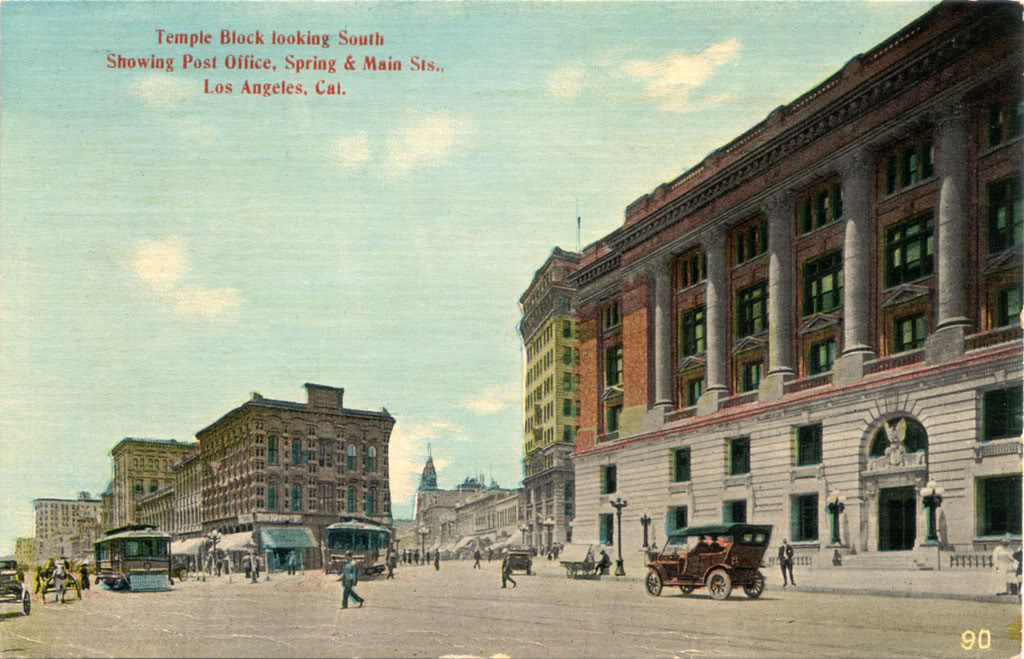
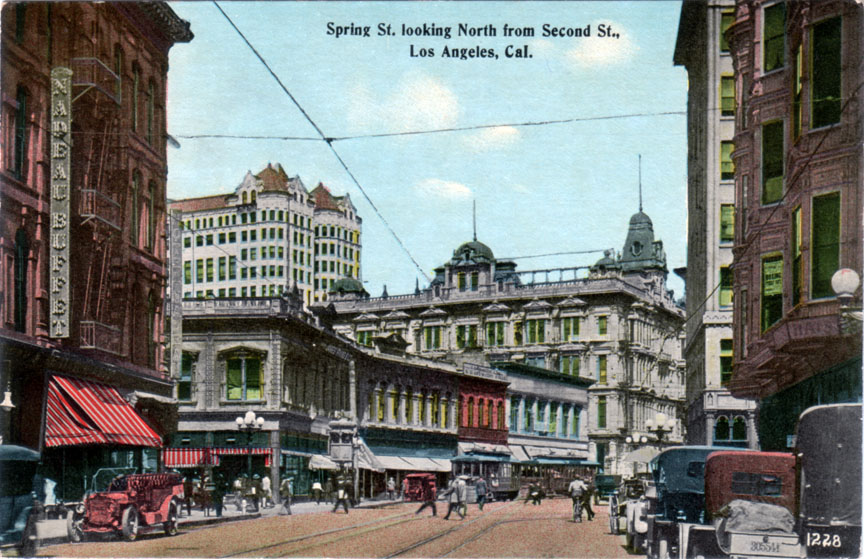
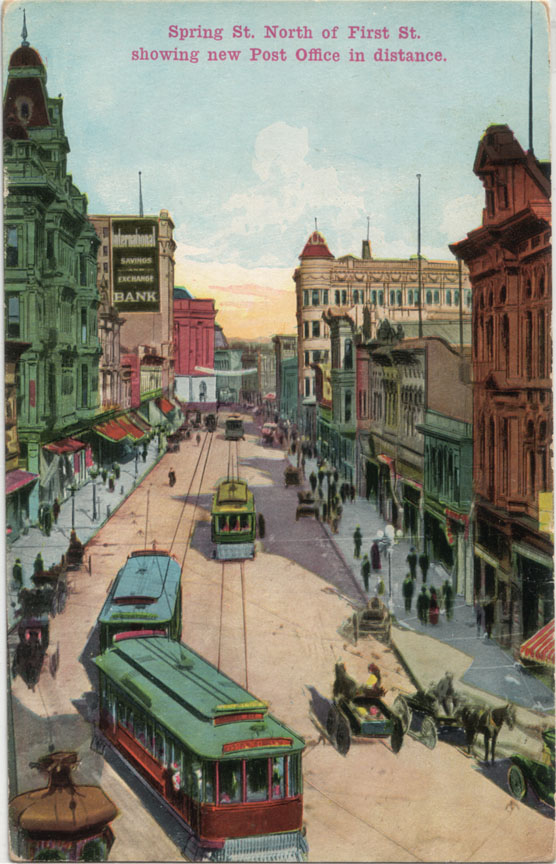
From the 1860s to the 1930s, Temple Square was the original "civic center" of Los Angeles. Formed by the junction of Main, Temple and Spring Streets, it was the nexus of everyday life in the old city. Here are some postcard views of Temple Square from the first and second decades of the 20th century...


Today, no one looking at the intersection of Main and Temple could guess that a grand open public space once existed there. Temple Square has vanished without a trace from the face of the earth...


Wednesday, July 1, 2009

My post office (again)


Here's a nice view of Temple Square looking west toward my (yes, my!) post office, from what would probably have been the intersection of No. Main Street and Commercial Street, otherwise known as Ducommon Corner. And, judging by where the cars are headed, I'd guess we're standing on the southeast corner of Main and Commercial, in front of the U.S. National Bank. When? Best guess, c.1910, probably not too long after the new post office first opened for business.

To get your bearings of where this was, the north bit of the present City Hall would today be visible just beyond the left edge of the postcard.

At left is the good ol' International Savings and Exchange Bank at what used to be the northern terminus of Spring Street, and between the two buildings can be seen a smidgen of the old Los Angeles County Court House at Temple and Broadway.


Saturday, May 2, 2009

The Spring Street diagonal

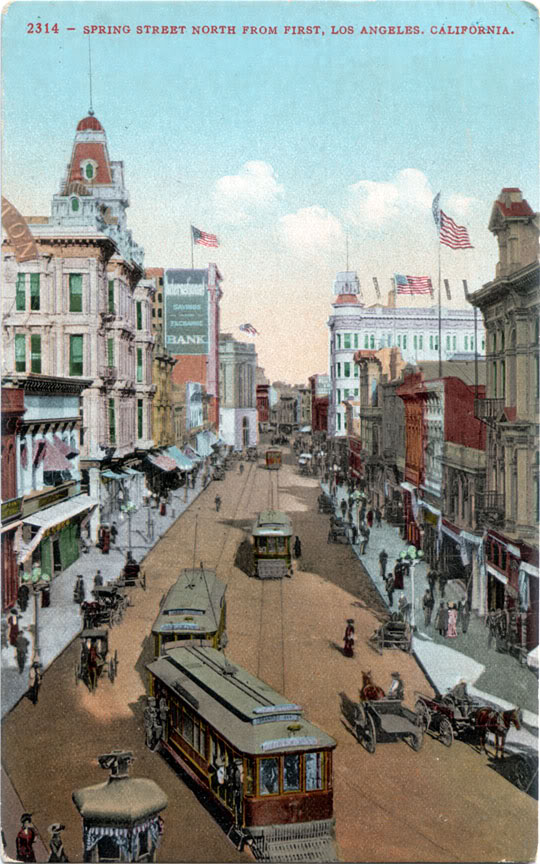
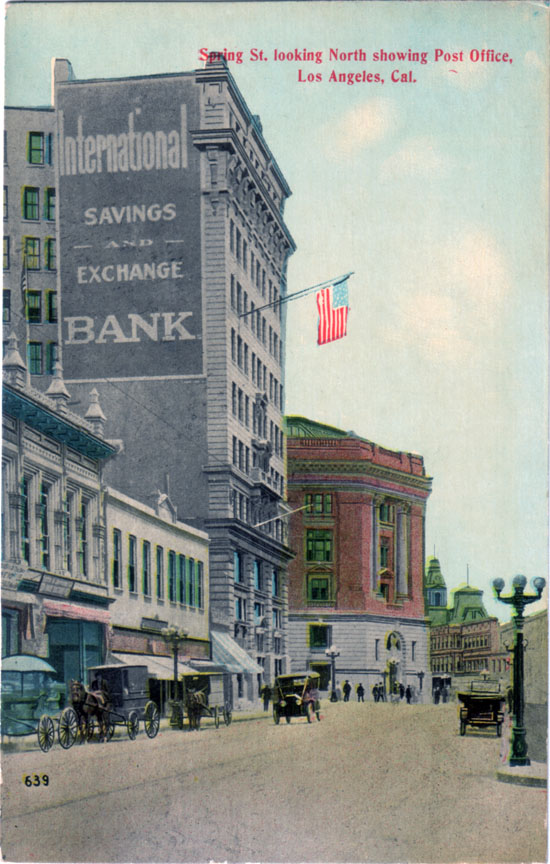
Ever since I started collecting postcards of old Los Angeles, this 90-year-old view of the north end of Spring Street has been one of my "holy grails." One reason for its desirability is that it features the old Post Office that first got me interested in pre-WWII Los Angeles. Mostly, though, this card fascinates me because this particular stretch of Spring Street no longer exists at all.


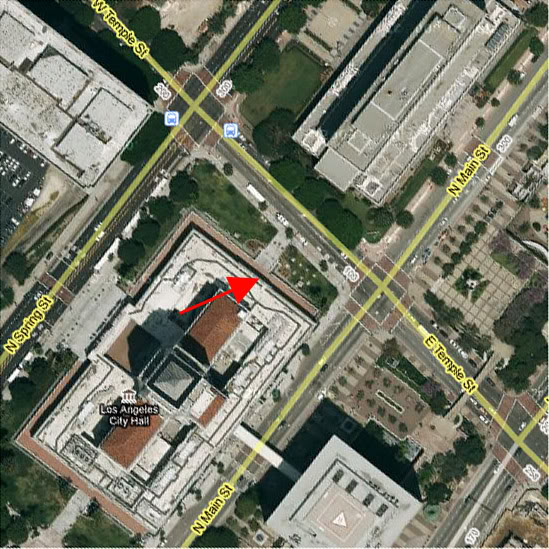
In fact, this portion of Spring's not only completely vanished, this exact vantage point is today located inside L.A.'s City Hall! (See position of red arrow below.)


Google Earth.


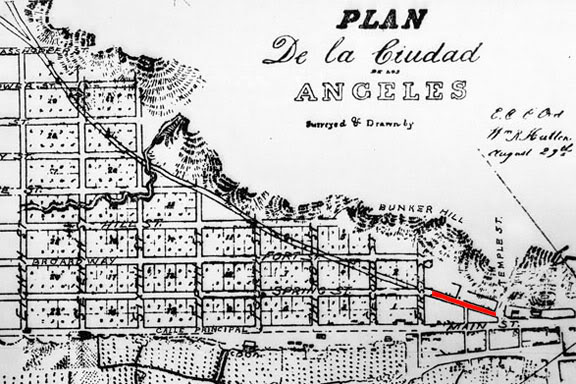
Here's the backstory. Before 1927, when work on the new City Hall began, Spring Street north of First Street did not run parallel to Main Street and Broadway as it does today. Rather, north of First, Spring jogged east-northeasterly, following a diagonal course to the intersection of Main and Temple (the postcard view). This short diagonal portion (also in red, below) was actually the last vestige of an old indian footpath along the base of Bunker Hill which pre-dated the establishment of the Mexican pueblo itself.


Detail from the 1849 Ord survey map.


Here are a couple of other postcard views of Spring Street as it was before 1927. This first one shows the intersection of Spring and First Streets, looking north, around 1915. You can see that Spring continues straight through past the intersection for about 30 or 40 feet, then it turns at an angle to the right. That's the beginning of the old diagonal alignment.


Now, if we were to go up on the roof of the building at the NW corner of Spring and First and look further up the street, this is what we'd see.


And there, near the end of Spring, is that International Savings and Exchange Bank building again, and the 1910 Post Office just beyond that.

A later perspective: here's a photo of the Civic Center in 1938, after Spring Street had been straightened. That structure just to the immediate right of City Hall is the same International Savings and Exchange Bank. Note the angle of the facade. That was the last visible evidence of the old diagonal alignment of Spring Street...


gsjansen on Flickr.


Monday, March 30, 2009

A prelude to terror


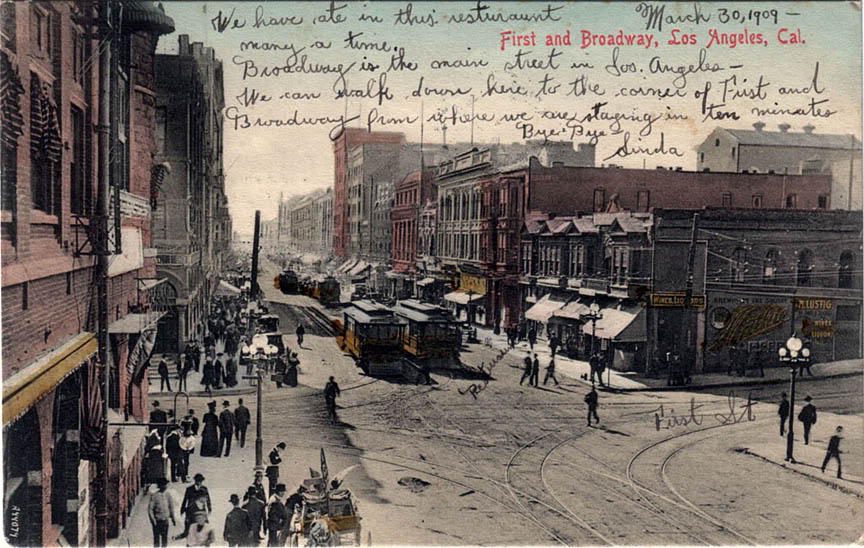
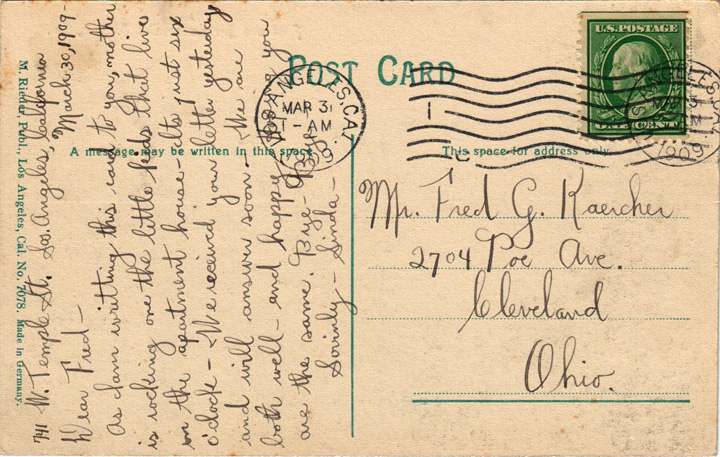
One century ago today – indeed, 100 years to this very hour – this postcard was penned in a long-vanished boarding house at Temple and Figueroa Streets in Los Angeles, and addressed to a now also non-existent residence in Cleveland, Ohio...


In 1909, the intersection of Broadway and First Street was the center of civic life in old Los Angeles. Today, however, absolutely nothing you see in this postcard still exists. Old San Francisco was destroyed by its famous earthquake and fire of 1906, most of Chicago was wiped out by its own Great Fire of 1871, but old Los Angeles was even more thoroughly destroyed by the hand of man himself.


In 1910, however, another kind of destruction would visit Broadway and First, when the building to your immediate left (you could almost reach out and touch it from this vantage point) would be dynamited into fiery rubble in the third most murderous act of domestic terrorism in the first half of the 20th century. Only the Wall Street bombing of 1920 and the Bath School bombings of 1927 produced higher death tolls than this anarchist attack in Los Angeles in 1910.

And yet, I doubt that even 1 out of 10,000 of the present-day residents of L.A. know about the horrific bombing that took place in their own city less than a century ago. I didn't, myself, before the history of pre-WWII Los Angeles became an avocation of mine a few years back.

I'll have more to say about the bombing at its centennial in October of next year...


Friday, June 13, 2008

Origin of an obsession


It was this building and this shabby old postcard of it that planted the seeds of my present obsession with pre-WWII Los Angeles.

It's kind of a long story, but I'll try to make short work of it. Back in late 2007, while browsing the Panoramic Maps collection on the Library of Congress website, I found a number of "bird's eye" views of old L.A. I'll never forget my reaction upon seeing them for the first time.

"I don't recognize anything here."

The two maps which most caught my eye were both dated 1909. They were the most detailed, by far. After searching them for a while, I finally found something familiar: the Bradbury Building at Broadway and Third. OK, now that I had my bearings, I kept scanning the maps and found what looked like a civic center: a Hall of Records and a Court House. And, nearby, a large Post Office. Strange thing, though. The two maps had two completely different drawings of that building. Which was the correct one?

A cursory web search proved fruitless, so, just on a whim, I searched eBay for 'los angeles post office', and up came this single postcard. The image was striking and completely unfamiliar. Surely if this building were still standing when I was growing up in the L.A. area, I would have remembered it.

But if such an expensive and ornate edifice – which was clearly meant to endure as a civic monument into the ages – was gone by the time I was born, what happened to it? Well, after studying the more-accurate 1909 map a bit more, I saw why. The old post office was located very close to where the 101 freeway "slot" would be constructed in the 1940s. No wonder everything in that vicinity was gone now...

At that point, I really wanted to find out what that part of town looked like back in the day. Googling again, I queried about the post office's location – Temple and Main Streets – and voilĂ , I found a Blogger entry by a "lastraphanger" entitled "Temple and Main Streets: What Used to be Here." Wow! With both text and photos, this guy answered every question I had about the locale and much much more. I was utterly fascinated by his descriptions of this vanished part of old Los Angeles, and upon searching his blog further, I was delighted to find an absolute wealth of new information there.

So I became an ardent reader of this anonymous person's weblog. Practically every day, I learned more and more about this L.A. I never knew. Unfortunately, less than two months after I found lastraphanger's blog, he moved on in life and deleted it. To this day, I lament the loss of that important historical document...

However, that loss ultimately proved beneficial, because since I no longer had someone else to rely upon to tell me about the history of old L.A., I had to dig up the knowledge I sought by myself. Back when I was a college student, I loved literature searches, and thanks to the various online archives and the wealth of information they contain, I quickly became adept at finding my own answers to practically every aspect of old L.A. that I was curious about. The result is what you see here in my blog today!


*smiles* I still remain rather fixated on that old post office, though. As with everything else about the vanished city, the more I find out about it, the more fascinated I become. Anyway, I will definitely have a lot more to say about this building when its centennial arrives in 2010. Trust me, it will be a tale well worth the telling!